Tuesday, December 20, 2016

A HIDDEN GEM - THE DEL GIGLIO CHAPEL


I love finding hidden gems in Florence and recently I added a new one to my list, the Del Giglio chapel at the Maria Maddelena dei Pazzi church in borgo Pinti.
The chapel was constructed in the early 1500s paid for by money donated from the Del Giglio family, inserted in the large portico in front of the church of then Cistercian monastery. Its purpose was to provide a prayer and medative space for women as they were allowed inside this church only twice a year. The Cistercian monks moved to the Oltrarno in the 1620s literally doing a swap with the Carmelitan nuns and their church Santa Maria degli Angeli in the area of San Frediano by order of Pope Urban VIII (Barberini). The nuns brought with them the uncrrupted body of their famous nun the Florentine nobilewoman turned nun Maria Maddelena. When Maria Maddelena dei Pazzi (of the important Florentine family, Pazzi) was canonised in the 1660s by Pope Clement IX the nuns renamed their church after her.
However, as mentioned above, the chapel was built before the arrival of the female Camelites and was built as a domaine for women who at the time of the Cistercian occupation had limited access to the church. This explains the chapel’s location in the portico in front of the church immediately on the right upon entering from the street.
The Del Giglio family were the patrons of the chapel’s construction as well as the altarpiece painting by Cosimo Rosselli of the coronation of the Virgin, a suitable subject for a place where women worship. This painting is now located inside the church in the second side chapel on the left.

In 1598 the chapel was passed to Nereo Neri who was the physician to the Grand duke Ferdinand I e Medici. He embarked on a large decorative program of the room which was reflected both a personal theme and that of the monastic order. The altar piece was replaced by one painted  by Domenica Passagnano depicting the martyrdom of Achilleo and Nereo (the patron’s name sake).
For the walls he commissioned Bernardo Poccietti  one of the artists most in demand in Florence at the time for the fresco decoration of both interiors and exteriors of large palatial homes in the city. Poccietti worked for the Medici grand dukes at Pitti Palace (in the palace as well as the decoration of the Grotta Grande in the Boboli gardens). His work can be seen still today in many places for example one of his great works was the façade of the Palazzo of Bianca Cappello on via Maggio commissioned by the Grand duke Francesco I for his mistress the blond Venetian, Bianca.
The chapel space is composed of two areas both square in shape, one larger than the other. The larger section was destined for the worshippers and the smaller square is the altar for the priest. In the smaller altar area the lateral walls depict the martyrdom and baptism of Achilleo and Nereo (matching the altarpiece painting).

The walls of the larger area are dedicated to Saint Filippo Neri (1515-1595) on the right side when facing the altar and Saint Bernard of Clairveux on the left. Saint Filippo Neri featured because once again, he shared the same name as the patron, this time though it was the same surname, Neri. Saint Bernard of Clairvaux featured because he was one of the key leaders of the first Cistercian monastery founded in the 1100s.
Saint Philip Neri was a Florentine priest who lived in the 1500s. He studied at the San Marco monastery in Florence (the reformed Dominican order) but afterwards most of his life was spent in Rome where he dedicated his time to helping the poor. Contemporaries often referred to him as the second apostle of Rome because of his work with pilgrim hospitality and the poor. He was the founder of the congregation of the Oratory of Saint Philip, more simply called the Oratorians. It was an order which didn’t require following a strict rule as most others, it was more a confraternity, and composed of a group of priests who lived together and shared the same mission of devotion to the underprivileged and particular interest in the youth. They held frequent meetings with the public and would combine religious discussion and lectures with music and singing which they called oratorios. The Oratorians wore black like priests often did. The frescos in the chapel show Filippo Neri dressed in black with a vision of the Virgin Mary and another receiving a vision of the nativity, donkey and all.

On the opposite wall is Saint Bernard of Clairvaux dressed in his characteristic white robes (they are one of the few monastic orders which dress in white instead of black). He was one of the founders of the monastic order in France founded in the eleventh century at Citeaux. The name they gave their order, Cistercian, refers to the Latin name for the town of Citeaux, Cistercium. The two scenes depicting Saint Bernard are opposite the two scenes of Saint Philip Neri. One depicts a miracle that happened to the saint and the other a vision.

Legend has it that Saint Bernard received some milk sprinkled on his lips by the Virgin. This was interpreted into art with the Madonna taking a pause whilst nursing the Christ baby and literally squirting the milk to Saint Bernard, often shown at quite a distance.
The ceiling was beautifully frescoes with the coronation of the Virgin which returns to the theme of the chapel being the place for women. Directly underneath the virgin being crowned both by God and Christ are three depicted larger than life female saints: Saint Cecilia (shown with an organ), Saint Catherine of Alexandria (shown with a broken wheel) and Saint Barbara (shown with a sword and chalice held by a cherub at her feet).

Today the chapel is used daily for prayer by the Augustinian friars who have been in the church and monastery since 1926 when the Carmelite nuns moved to just outside the historical centre to Careggi. When not being used by them the chapel remains closed. However, if you ring their door during the times that the church is open they may just open it up for you……

SEASON'S GREETINGS


Tuesday, March 15, 2016

SARTEANO WEEKEND – SOUTHERN TUSCANY


I just spent a great weekend in southern Tuscany, so good that I wanted to share it for those who don’t know this neck of the woods.

Accommodation: I stayed in the abbazia di Spineto www.abbaziadispineto.com for two nights, just outside of Sarteano. It was simply wonderful. The abbey is celebrating their 1000th year anniversary this year, pretty incredible. It was bought in ruins in the 1980s by a couple who have restored it with grace and care without missing any nook and cranny, nor with a penny spared. The church of the abbey is still consecrated and so it is a popular place for weddings as the property is a one stop shop being able to supply the church service and the reception. There are many restored properties surrounding the main complex (villas, smaller houses, etc.), however, we stayed in the abbey proper in a wonderfully comfortable double room. The excellent breakfast was in a small dining room with one of those old fireplaces with seating benches inside the stone frame of the fireplace. It was a wonderful way to start the day.

Towns: we visited Sarteano, Cetona (part of the ‘100 borghi più belli dell’Italia’ category) and Chiusi.

Art:


Sarteano: Saturday mornings it is possible to visit a spectacular painted Etruscan tomb, the tomb of the Infernal Chariot (IV century B.C.). Bookings are essential through the local city museum of Sarteano www.museosarteano.it and tickets need to be paid here in advance. The tomb is located a few kilometres outside the town. Up close and personal without any barrier to the Etruscan frescoes in the tomb is an exhilarating experience. In spectacular condition they show a banqueting scene, a chariot scene with one of gods of the underworld, Charon, at the reins of a chariot being pulled by griffons and lions.

Chiusi: The archeological museum in Chiusi houses a great collection of Etruscan artefacts. The collection is outstanding and the museum is modern, well organised, well lit and well labelled, which makes for a very enjoyable visit.


Cetona: A walk around this small town along all the very narrow streets is lovely. The inhabitants seem all very house proud with many flower pots and scrubbed clean stone flagstones.

Food:

I had three magnificent meals.

Sarteano: Da Gagliano, no website Phone: 0578 268022

This was the second time for me here. The first time was for lunch and we liked it so much that this weekend was largely fuelled by the thought that we would eat here again, this time for dinner. The place was small and run by a couple, hubby on the floor and wife in the kitchen. It is Tuscan fare and all locally sourced ingredients and wine list. Four courses here because I knew that I would feel food envy if I had left one out…..they are listed in the Slow food guide and have been awarded a snail by the guide, which is a symbol of recognition for quality and slowness….. deserved.

Dessert at da Gangliano Sarteano
 
Cetona: Il Tiglio di piazza da Nilo

This was recommended by the owner of the abbey (accommodation). It was excellent. Lovely service, great menu, great wine list. The restaurant was full of locals for an evening of great food in good company. The restaurant is next to a bar / caffe where we had stopped in earlier in the afternoon for a coffee and a sneaky chocolate. There is nothing like the old school Italian coffee bars where the barman is dressed in his uniform and he makes a good coffee and is ready for a chat. Always a pleasure. We stopped in here for an after dinner digestive because we didn’t want the evening to end.

Chiusi: Il Grillo è buoncantore www.ilgrillobuoncantore.it

This was again one from the Slow food guide and also highlighted with a snail…. Again deserved. Three courses later, my only regret was that I hadn’t also ordered a primo to try their fresh pasta. I asked for seconds of the bread basket because their homemade bread was simply perfect. It didn’t come out immediately because she actually was making it for me on the spot (it was a sort of piadina). Again, a husband and wife partnership with the husband on the floor and wife in the kitchen. Every.single.ingredient. was sourced from a local producer. It was really astounding.

 
The antipasto was all home grown
Enjoying the Guinea fowl

This area is known for thermal baths. I didn’t visit any this trip….. I had to leave something for me to come back to. I will not be looking for new restaurants nor different accommodation because I want to go back to the same and start the experience all over again. 

Saturday, December 12, 2015

ARTEMISIA GENTILESCHI - A PIONEER FEMALE ARTIST


Artemisia Gentileschi (1593-1653) depicted Judith from the Old Testament at least four times in painting; she quite possibly had painted more of this subject but as not all of her oeuvre has survived, we cannot be sure. Judith is the female equivalent of David in the Old Testament. She, like David, against all odds, saved her city from an enemy. Holofernes, an Assyrian general, was camped outside her city with his army intent on attacking it the following day. Judith, a virtuous and chaste young woman, aided by her maid servant Abra, took the situation in hand the evening before the attack and stole into Holofernes’ tent. All glammed up and oozing charm, she managed to get Holofernes to drink copious amounts of wine to the point that he was inebriated and weakened.  She then took his sword and beheaded him, putting his head on a pike in the camp site for his soldiers to see the following morning. Without a leader, they retreated and her city was saved.


Artemisia shared several characteristics with Judith. The two woman had a strong sense of independence, determination and strength, and neither was afraid of tackling seemingly unsurmountable tasks. Artemisia painted many female subjects, in particular women who were put on trial or had been accused of something, such as Susanna from the Old Testament or Lucretia from Roman Antiquity. She was not only a painter in her own right, which was basically unheard for a female in the early seventeenth century, but was the first woman to be invited to join the Accademia del disegno in Florence, the first Fine Arts Academy in the modern world.
Born in Rome, she trained under her father, Orazio Gentileschi, in very early years of the 1600s and by her early teenage years she was the driving force of the workshop beside her father. This was the period that the northern Italian artist, Caravaggio, had created shock waves through artistic Rome with his dramatic and powerful style imbued with high tension and psychological weight. Artemisia was hugely influenced by his style. His technique proved to be the best vessel through which she could transmit the energy, strength and power that she longed for her canvases to communicate. She, like Caravaggio, pared down the number of figures in her scenes so as to spotlight even more the depicted moment. She too used sharp contours, primary colours and dramatic lighting like in a theatre (strong chiaroscuro).
Like Caravaggio, in many of her works, she managed to covey a running moment of time. Somehow she managed to depict her subjects in such a way that our mind continues with what could be the following scenes that would take place after the one on the canvas in front of us. Using as an example the two very similar paintings of Judith and Holofernes hanging in the Uffizi gallery in Florence and the Capodimonte museum in Naples, we see that Judith is in the middle of killing Holofernes; the action has started but is not yet finished. We as spectators, feel the mid-kill, the blood is spurting up and will stain Judith’s dress and we feel the strength that Holofernes still has in attempting fight of Alba the maidservant.  And finally, we see the complete conviction in Judith’s expression. He is not yet dead but no longer really alive.
Now let’s take a look at the paintings depicting Judith and Abra alone, hanging in the Pitti Palace in Florence and the Detroit Institute of Arts. Here the killing is done and they are carrying the general’s head. Where is the mid action here? They are still in the camp, in enemy territory, and they have just heard a sound and their heads are shown whipping around to see who is there! Artemisia wraps us up in the tension of the scene, the drama and the suspense. We become part of the painting.


One month after the trial had finished her father organised for her to be married to a relatively little known Tuscan artist and she moved to Florence. Here, however, she earned fame for her talent and her person. She was particularly esteemed by the Medici Grand Duke Cosimo II and his wife the Grand duchess Maria Maddalena of Austria and some of their most illustrious court members, such as the court astronomer and mathematician Galileo Galilei, and one of the most brilliant intellectuals in the city, Michelangelo Buonarroti the Younger (the master artist’s great nephew). Both the Medici and Buonarroti commissioned works from her and Artemisia and Galileo wrote numerous letters to one another.
Strong in art and strong in nature, Artemisia was all girl power in a man's world!


Saturday, October 25, 2014

THE PORTINARI ALTARPIECE


In the Botticelli room of the Uffizi gallery there is a huge lonely masterpiece. It stands for the most part alone without admirers as it is outshone by its more famous contemporary, the Birth of Venus by Botticelli, located directly opposite. However, when this painting arrived in Florence on May 28 in 1483, it was a huge hit and people fought to see it just like they do with the Botticellis in the room today.


This very large triptych (a composition made up of three paintings) was commissioned by a Florentine banker, Tommaso Portinari, who had been living abroad for decades, in Bruges,  working for the Medici bank. When his ex-patriot stint  finished and he returned home, he brought with him some art work that he had commissioned form the fashionable native contemporary painters of his host area, Flanders. He commissioned the above mentioned  altarpiece from Hugo van der Goes for his family’s local church, Sant’ Egidio, the church of the Santa Maria Nuovo hospital. The hospital, which is still one of the major hospitals in the city today, had been founded by his ancestor, Folco Portinari (the father of Dante’s muse, Beatrice) in l288.

The central panel of the triptych depicts the adoration of the shepherds. The flanking panels depict the Portinari family with their individual namesakes. On the left are the males of the family, the head of the family, Tommaso, with Saint Thomas behind him (the saint is holding the spear that was used to make the wound on Christ’s side) and his two sons, Antonio and Pigello, with Saint Anthony Abbot behind them (Anthony is holding his attribute, a little bell). The right panel depicts Tommaso’s wife, Maria, and their daughter Margherita, and behind them are Saint Margaret (the saint is holding a cross and a dragon is at her feet) and Mary Magdalen (the saint has the perfume bottle to wash Christ’s wounds after the deposition from the cross).


The middle and main panel depicts the Adoration of the shepherds. The Virgin Mary looks down at her baby who is lying directly on the ground on wheat. The wheat is a reference to his future death and thus ensuring salvation for mankind, wheat being symbolic of the Eucharistic host. The masterfully depicted cow and ox to the left of the scene look on silently and reverently. They are in shadow, under the barn shelter; however, the detail in the beautiful muzzle and nose doesn’t go unnoticed. Joseph looks on from the far left of the painting with his hands clasped in pair and sign of his awareness of the holiness of the scene in front of him. His hands catch the light and the realism of the rough worked skin is unbelievable. The three shepherds are grouped on the right. They too have been depicted with extraordinary realism, hyper realism, the antithesis of airbrushing. The painter shows them in the raw; they are ugly and lined after years of living outside with the elements. The painting is skilfully developed on a diagonal which creates a sense of dynamism to the scene, not to mention, uniqueness.


The delightful shoe, one only in front of Joseph makes the eye notice the individual wheat stalks and the delightful still life in the central foreground. These flowers in the foreground would have been read immediately by the public as religious symbols relating to the people depicted behind. The red carnations symbolise love and the white irises are for purity, the violets are for humility and the blue irises are heaven and the orange lilies for the Passion of Christ.


The flanking panels are double sided as the altarpiece would be closed when not being used for ceremonies and prayer. The frontispiece panels depict the Annunciation, the Virgin on the right and the archangel Gabriel on the left. It is executed using the technique of Grisaille. This is a monochrome painting executed in shades of grey.


The altarpiece was finished in 1475 it was put on a boat which sailed to Sicily after which the painting was put on a boat to Pisa and then it was brought to Florence on a barge dragged up the Arno river to the porta San Frediano. It was carried by sixteen porters to the church close to the cathedral. When the painting arrived in Florence it caused quite a commotion amongst the artistic community. The painting’s strong realism and microscopic  attention to details coupled with the intense moving humanity in the facial expressions of the shepherds were all so different to the Italian priority given to the ideal aspect of the figures. Domenic Ghirlandaio’s painting of the same subject matter, Adoration of the Magi, from 1585, is exemplary in showing the influence that Hugo van der Goes’s great masterpiece had in the city.


The painter, Hugo van der Goes,  was from Ghent and very little is known about his life. This painting is considered his masterpiece. He was registered as a painter with the artists' guild in Ghent in 1467. He became the dean of the guild in 1475 and maybe the same year entered a monastery in Brussels. However, he still travelled.  It seems that he suffered from depression and had a mental breakdown in 1481 and died the following year. The Portinari triptych is the only painting which can be ascribed to him with certainty. It is unsigned however. Vasari also mentions it in his Lives of the Artists. 


Monday, May 5, 2014

PALAZZO MELLINI-FOSSI


The splendid palazzo Mellini-Fossi is in via de Benci at number 20. The land was bought by Duccio di Noferi Mellini in the 1460s and the facade that we see today is thought to have been built in the beginning of the 1500s. The style is in line with that of the Cronaco (palazzo Guadagni in piazza Santo Spirito) and Baccio d’Agnolo.

The style reflects a palazzo of a wealthy merchant from the second half of the 1400s to the first half of the 1500s. Each of the three storeys of the palace is demarcated by moulded string courses and it is five window bays wide. There is the characteristic Florentine feature of the bench in the ground floor and a wine door on the right. Finally, there are also the typical extended eaves from the roof. The building was sold numerous times before becoming the property of Marquess Federico Fossi in 1890, explaining the palazzo’s current name, palazzo Mellini-Fossi.

The facade has the most wonderful fresco decoration. They are in good condition after the restoration from the Opificio in 1994-96. However, I can’t imagine what splendour it would have been when just finished in its entirety in the 1570s. This was during the reign of Grand duke Francesco I and his wife, the grand duchess, Joan of Austria, which explains the huge coat of arms in the middle above the main entrance of the palazzo. Half is the Medici crest, the other half, the crest of Joanna of Austria.

Decoration has all but disappeared on the bottom half of the ground floor but it remains for the most part recognisable, on the first and second floors

The decoration depicts scenes from the life of Perseus, from his birth to the most famous events in his life.


Who was Perseus?

His mother was Danae. Her father, Acrisius King of Argos, had no sons and consulted the oracle at Delphi who warned him that one day he would be killed by his daughter’s son who she would have with Zeus. Consequently, to avoid Danae from ever having any contact with the outside world, he kept her in a bronze chamber in the palace open to the sky. But Zeus came to her in a shower of gold. After she had Perseus (a demi-god), Danae’s father wanted to rid himself of both of them to keep his power but,  not willing to provoke the wrath of the gods by killing them both, he cast them into the sea in a wooden chest. They were found by the brother of the ruler of a new land and given shelter and looked after in this new community. The ruler was Polydectes, who fell in love with Danae. Perseus however was protective of his mother and refused to let Danae near him. He hashed a plan to rid himself of Persues. He planned a false marriage and when the guests arrived with presents, Perseus, who was invited, didn’t arrive with anything as they were poor. Polydectes pretended to be furious and called Perseus hopeless. Perseus exclaimed that he could bring any present that he wished. Polydectes demanded the head of Medusa, the Gorgon.

Perseus walked for days on the land of the Gorgons where these frightening women lived with snakes as hair and when you looked at them you turned into stone. He was feeling desparate when one day Hermes (Mercury) and Athena (Minerva) appeared to him. They were all children of Zeus, his half brothers and sisters. Hermes gave him his winged sandals and the sickle, which Cronos (Saturn) used to overpower Uranus, to kill Medusa. Athena gave him a shield so polished that he would be able to see the reflection of Medusa rather than looking at her directly. They told him to go find the Graeae who would tell him how to find the Nymphs of the north who would in turn give him the cap of darkness and a magic wallet as well as tell him how to get to the Gorgon’s lair. The three Graeae were perpetually old cranky women who shared one eye. Perseus hid behind a bush and watched them and then when one handed the eye to another, he sprang out from the bush and grabbed it. He threatened to never give the eye back unless they told him where the nymphs lived, so they did. The nymphs gave Perseus the cap of Darkness, which makes the wearer invisible, and the magic wallet where he can put the head. They told him how to arrive at the Gorgon’s lair. He went very far north until he found an island surrounded by rocks and statues which used to be men but were now turned into stone. He saw medusa sleeping in her lair along with her sisters and beheaded her with the sickle, looking at her on his shield, and put her head in his bag. When her sisters woke up and chased him he put on the cap of Darkness and flew away.

On his way back home he saw Andromeda chained to a rock about to be eaten by a sea monster. He flew down and showed the sea monster Medusa’s head and the monster turned to stone. He freed Andromeda and they were married. There was a fight during the wedding celebrations with Phineus who had had his eye on Andromeda before Perseus came onto the scene, and he was turned to stone also. Flying back home they stopped at Larisa, the birth place of both Danae and Perseus (not that he knew this) and he participated in some games. He threw a discus which hit Acrisius, the king and his grandfather, in the crowd and he died. The oracle was right!


He finally arrived back home with her and entered Polydectes’ court and told his friends to shield their eyes and then showed Medusa’s head and Polydectes and his courtiers turned to stone. He and Andromeda ruled there after.

So the next time that you are standing in front of the palazzo Mellini Fossi check out the scenes:


On the ground floor from left to right:

Perseus slaying the sea monster, Andromeda chained to the rock, the coat of arms of the Medici/Hapsburg (above), Phineus and his followers being turned to stone.
There are eight scenes, from left to right:

Acrisius, king of Argos before the Delphi oracle, Danae seduced by Jupiter, Danae and her newborn child cast into the sea in a wooden chest, Persues receiving the shield from Athena and winged sandals from Hermes, Perseus removing the Graeae’s only eye, Perseus slaying the Gorgon Medusa, Perseus with Pegasus seeking shelter from Atlas, Perseus brandishing the head of Medusa.

Tuesday, December 3, 2013

TORNABUONI CHAPEL IN SANTA MARIA NOVELLA


Giovanni Tornabuoni in the late 1400s was one of the most wealthy and influential men in Florence. He was the treasurer for Pope Sixtus IV (pope 1471-1484), an extremely lucrative job for him and the family.

Giovanni Tornabuoni: detail from the Tornabuoni chapel, Santa Maria Novella, Domenico Ghirlandaio, 1485-90, fresco.
He was married to Francesca, the daughter of Luca Pitti. His two sisters were married to rulers of the city at two separate times: Lucrezia Tornabuoni  was married to Piero the Gouty de Medici, the unofficial ruler of the Florentine republic (they were parents to Lorenzo the Magnicent) and Dianora, his other sister, was married to Pier Soderini, the Gonfaloniere of the restored republic (1498-1512) of Florence after the Medici family were exiled.

The Tornabuoni family lived on the eponymous street not too far from the Santa Maria Novella church. Their huge family palace today is managed by the Four Seasons group and has a restaurant and shops on the ground floor. The family, originally called Tornaquinci, changed their name to Tornabuoni so that they could participate in the government. The family preferred to renounce their noble status and name rather than remain on the outside of one of the most innovative and largest populated cities in Europe at the time. The palazzo, now often referred to as Tornabuoni-Corsi, was built by Giovanni Tornabuoni on designs by Michelozzo. It was then sold to the Ridolfi family in the middle of the 1500s and then to Alessandro de Medici, Archbishop of Florence in late 1500s.

Palazzo Tornabuoni in via Tornabuoni,
Giovanni Tornabuoni decided to pay for a renovation of the frescoes in the very large central chapel inside the Dominican church of Santa Maria Novella. This chapel had been under the patronage of the Ricci family since the 1300s. Andrea and Bernardo Orcagna, in the middle of the fourteenth century, had decorated the chapel with scenes from the life of the Virgin Mary on one wall and scenes from the life of John the Baptist on the other. However, these frescoes had suffered water damage after lightning had damaged the roof in 1358 and, coupled with a general neglect on behalf of the Ricci family who hadn’t made any attempt to upkeep the decoration, Giovanni Tornabuoni decided to offer to pay for an all round restoration of the whole space. 

View of the Tornabuoni chapel, Santa Maria Novella Church, Domenico Ghirlandaio, 1485-90, fresco.
In the late 1480s,  Giovanni Tornabuoni commissioned Domenic Ghirlandaio’s workshop to carry out the new work. He promised the Ricci family that the new work would respect the existing subject matter (it worked out well as one of the walls was dedicated to the patron saint of Florence also his namesake). He also, initially, said that the Ricci family would keep their coat of arms in pride of place in the chapel for all to see, something that he did not honour.
Domenico Ghirlandio had one of the largest painting and fresco workshops in the city at the time. It was a family workshop comprised of his two brothers, Davide and Benedetto, and his brother in law, Sebastiano de Mainardi from San Gimignano, who had married his sister Alessandra. The Ghhirlandaio family’s real surname was Bighordi, but they had decided instead to adopt the appellation, Ghirlandaio, which means garland maker. Their father, a goldsmith, had made a name for himself in earlier decades making garlands for woman’s hair. Bighordi, however, is written into the wainscoting of the room in the scene Birth of the  Virgin Mary.

Ghirlandaio and the workshop work on the chapel for 3 years. They finished it in 1490. This date is included in the inscription on the arch in the bottom register of Apparition of the angel to Zaccheriah. The inscription says: An (anno) MCCCCLXXXX quo pulcherrima civitas opibus victoriis artibus aedifichiisque nobili(s) copia salubritate pace perfruebatur - during the year 1490 the most beautiful city for wealth, victories and commerce, famous for its monuments, enjoyed abundance, health and peace. 
The third middle wall, houses a magnificent stained glass window depicting six saints, three to each side, and in the middle of the window are three scenes featuring the Virgin Mary: from the top, the Madonna giving her girdle to Saint Thomas, the Assumption, Madonna and the miracle of the snow. The chapel is dedicated to the Assumption of the Virgin, thus explaining the subject choice for the middle of the window.

Stained glass window, central wall of the Tornabuoni chapel, 1491, Santa Maria Novella Church, Domenico Ghirlandaio. 
The ceiling is divided into four parts and shows the four Evangelists with their respective symbols (Mathew – Angel, Mark - lion, Luke – bull, John – eagle).

Michelangelo joined Ghirlandaio’s workshop when he was thirteen years old in 1488. He learnt painting and fresco in this workshop for two years. He learnt the fresco technique working on the Tornabuoni chapel. Afterwards, at fifteen years old, he would start to learn sculpture in the Medici sponsored sculpture garden under the direct patronage of Lorenzo the Magnificent (Giovanni Tornabuoni’s nephew).

This chapel is higher and wider than all others in the church. It is spectacular and it was a perfect display of the status of the patron. He commissioned the carved wooden choirstalls from Baccio d’Agnolo.

In the lower registers, closest to the viewer, there are many spectators witnessing the religious scene. They have distinctly individualised features, most of them are portraits of Giovanni’s family, the heads of the leading families in the Oligarchy which controlled the Republic of Florence and the leading philosophers of the day. The Apparition of the angel to Zaccheriah depicts the leading people in society at that time. Howver, it this world depicted by Ghirlandaio was coming to an end. In 1494, four years after the fresco was finished, the Medici family were exiled and Girolamo Savonarola began to rule, a Dominican friar who replaced the Oligarchy with a theocracy. After the four years with Savonarola, the republic would be restored, however, it was a rocky and uncertain time both internally and externally with the other city states and foreign kingdoms (France and Spain).

Giovanni’s daughter, Ludovica Tornabuoni, is featured in the Birth of the Virgin (the woman in the photo below depicted in yellow) and Giovanni’s daughter-in-law, married to his only son, Giovanni degli Albizi, is depicted in the Visitation (image depicted above). Giovanna had already died when the fresco was finished, she died at fifteen years old in childbirth.


Thursday, November 14, 2013

LAOCOON


With the reorganisation of the Uffizi gallery, the exit is no longer mid-way down the third corridor, but at the end of it. This brings the Laocoon sculptural group, a 1500s copy of the famous ancient sculpture, once more as a protagonist in the gallery. Located at the end of the third corridor, previously overlooked by most, visitors to the gallery are now forced to walk right up to it in order to leave the building.

The Laocoon Group, marble copy by Baccio Bandinelli after the Hellenistic original
This copy was commissioned to Baccio Bandinelli by Cardinal Giulio de Medici in the early 1500s. It was originally intended to the be sent as a gift to the French king Francis I, however this was never followed through. The sculpture stayed in Florence where it was displayed for centuries in the garden of the Medici home on via Larga (modern day via Cavour).

Raphael, portrait of Pope Leo X with cardinals Giulio de Medici and Luigi de Rossi, 1518-1519, Uffizi Gallery
The eponymous protagonist of the sculptural group is an Apollon priest of Troy who is depicted, along with his two sons, being strangled by sea snakes. This ill fated death was sent by Neptune and Athena who wished to stop Laocoon from persuading his fellow Trojans to refuse the gift of the wooden horse from the Greeks. Laocoon had understood that this was a clever ruse on behalf of the Trojans' enemy, the Greeks, to enter the city and that there were no good intentions about it. The gods wanted the Greeks to win and so they were making sure that nothing prevented the outcome that they desired.

The original sculpture, from which the group in the Uffizi gallery is a direct copy, is thought to be from the 1st century BC from Rhodes. Pliny the Elder (AD23-AD79), the Roman historian, named three sculptors responsible for the group, Agesander, Athenodoros and Polydorus. Its fame spread far and wide upon its creation and much was written about it, with great praise. Centuries later in the renaissance period, this original sculptural group was unearthed on 14 January in 1506, in the area close to Santa Maria Maggiore in Rome. Pope Julius II immediately claimed it as papal property and the sculptural group was placed in the Belvedere courtyard in the Vatican palace, where it remains today.

The sculpture became one of the most influential works of the century.  Artists from far and wide came to draw it and etchings were sent to courts all over the continent. The deep pathos, drama and intense emotion of the figures, particularly expressed by Laocoon himself, opened up new avenues of expression in the renaissance world.

Head of Laocoon, detail of Laocoon Group
The rational renaissance, full of self control and restraint, is forgotten when looking at this most highly charged work. It is an exemplary work of the Hellenistic period, which succeeded Classicism.
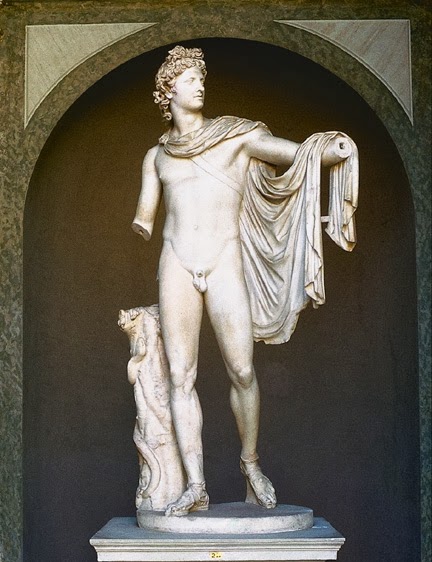
In the Belvedere courtyard of the Vatican museums, home to the original Laocoon, there is also the Apollo Belvedere sculpture, one of the other most beautiful sculptures in the collection, and which embodies the qualities of the classical period. In this sculpture, all emotion is contained and internalised and nothing but calm confidence resonates from the god who has just shot an arrow from is bow (now lacking). The placements of the two great sculptures in the Belvedere courtyard means that you don’t have to move to be able to see them both very well, each of them individually occupying a deep recess in the courtyard but close to one another. Each work perfectly embodies the characteristics of the two most important and strongly different styles from antiquity -  Classicism and Hellenism.

Apollo Belvedere, Roman copy after a Greek bronze
The Laocoon copy by Bandinelli in the Uffizi was commissioned in 1520 by the future second Medici pope, Cardinal Giulio de Medici. The patronage is evident because of the cardinal’s symbol on the original pedestal underneath. Paolo Giovio, an intellectual from Como living in Florence was responsible for the cardinal’s impresa (personal motto and symbol), a transparent crystal ball through which a ray of sunlight shines and hits a tree setting it alight. The motto is 'candor illesus' (purity unharmed).
The sculptural group was commissioned in Rome by the Cardinal for his cousin, Pope Leo X, who wished to gift it to King Francis I of France. After Pope Leo X’s death in 1521, Bandinelli and Cardinal Giulio living in Rome, returned to Florence leaving the marble in Rome. Upon Giulio’s election to Pope in 1525, they both returned to Rome and Bandinelli resumed work on the Laocoon group. Giulio, now Pope Clement VII, no longer had plans to send the work to France, but instead sent it to the Palazzo Medici for the garden. It replaced the bronze Judith and Holofernes group by Donatello which had once been in the garden of the Medici palace but was then taken to the town hall (where it is today) when the family was exiled in 1494.

Donatello, Judith slaying Holofernes, bronze, late 1450s, Palazzo della Signoria
When the Laocoon arrived in the Medici palace garden, there was already another work by the Bandinelli located in the courtyard, the Orpheus statue, which had been there since 1519. It too replaced a work by Donatello, the famous bronze David commissioned by Cosimo the Elder. Once located in the centre of the courtyard, it too had been taken to the town hall after the family’s exile. Interestingly, Bandinelli’s Orpheus deliberately draws inspiration from the above mentioned ancient Apollo Belvedere statue which, discovered in the late 1400s, had been in the Vatican courtyard since 1511. Bandinelli would have had ample opportunity to draw and study it.

Baccio Bandinelli, Orpheus, 1519, marble, Palazzo Medici-Riccardi
Just as, in the Vatican, the Laocoon and Apollo are still today in close proximity, the copy of the Laocoon and the Orpheus (inspired by the Apollo), both by Bandinelli from the same patron, were in the same location, the Medici palace,

Donatello, David, 1440s, bronze, Bargello National Sculpture Gallery
Unlike Orpheus however, after the sale of the palazzo to the Riccardi family in 1659, the Laocoon was transferred to the Casino di San Marco and then entered the Uffizi with the legacy of Cardinal Carlo de Medici.

Saturday, October 19, 2013

THE LAST SUPPER - SANT'APOLLONIA CONVENT

The Refectory room of the cloistered Benedictine nuns of Sant'Apollonia, Florence.
The scene of the Last Supper with Christ and his disciples before the crucifixion is the most commonly found decoration in the refectories (eating rooms) in convents and monasteries from the 1400s onwards. The symbolic meaning is that the members of the religious order eat with Christ, and they are perpetually reminded of Christ’s sacrifice, represented symbolically through the bread and wine, staple features at every meal. Most of the time meals were held in silence with somebody reading from the bible, which is why a pulpit is sometimes still present in these rooms.

The first representation of the last supper decoration in a refectory occurred in the middle of the 1300s in the Franciscan convent in Florence, Santa Croce, frescoed by Taddeo Gaddi. It is not depicted however, as the main wall decoration but underneath the large central tree of life.

The Last Supper and Tree of Life, Taddeo Gaddi, refectory in Santa Croce church,  1360s, Florence.
The first representation where the Last Supper is the central and most important scene on the wall of a refectory, superseding that of the crucifixion, is in the female monastery dedicated to Sant’Apollonia in Florence, on the other side of the city. This was frescoed by the early Renaissance great master, Andrea del Castagno in 1447. Interestingly, it was not mentioned in the chapter dedicated to the painter in the first art history book written by Giorgio Vasari in 1550, because being a cloistered female monastery, Vasari and others had no access to it and did not know of its existence. The convent was suppressed in 1808 and only then was the fresco bought to the attention of academics. Access was limited, however, until 1891 when the refectory and some surrounding rooms were acquired to open a museum celebrating the masterpiece.

The artist, Andrea del Castagno, was Tuscan and his name tells us from where he hailed.  Castagno is a small mountainous village in the province of Florence (his name literally translates as Andrea from Castagno). In a lovely turnabout of importance, however, this town is now called after him, Castagno d’Andrea (Andrea’s Castagno) reflecting his importance in painting in the early renaissance period. Andrea embraces the new style of strong realism in pictorial depiction, regarding both the representation of space, three dimensionality, and the desire to convey emotion and expression in the figures. He is thought of as being a Donatello in painting, with his strong contours and prioritising the portrayal of the human psyche, even at the expense of elegance and detail.

Last Supper, Andrea del Castagno, fresco, convent of Sant'Apollonia, 1447, Florence. 
Andrea’s Last Supper composition is the most typical way to represent the scene, with Judas on the side of the spectator, until Leonardo’s work in the refectory of Santa Maria delle Grazie in Milan, when he is placed on the side with all the other Apostles and Christ.

Detail of central section of the Last Supper, Andrea del Castagno, refectory of Sant'Apollonia convent,  1447,  Florence.
The precise moment that is being represented is when Christ announces that one of the people present will betray him. John, seated on one side of Christ, is so grieved to hear this statement that he bends over and and puts his head on the table. When asked who it will be, Christ says it is the person to whom he gives the bread dipped in the dish and then he gives it to Judas (the gospel of John). Peter is most often seated on the other side of Christ and sometimes is looking directly to Judas.

As shown in the above photo, the Last supper scene in the convent of Sant’Apollonia is accompanied by three smaller scenes above; the resurrection, the crucifixion and the Ascension to heaven.

This refectory is open Tuesday-Saturday 8.15am-1.50pm, free admission, via 27 Aprile 1.

Friday, August 23, 2013

THE MAP ROOM OF PALAZZO VECCHIO - A TRUE GEM


The medieval Palazzo Vecchio is a gem of a museum. There are so many interesting nooks and crannies and it spans the great Florentine period, from the republic in the medieval period to the dukedom from the 16th century onwards.

La Sala delle Carte Geographiche (the room of the geographic maps) is truly a gem! It was created by Cosimo I, the second duke of Florence in the second half of the 1500s. Moving into the government building in 1540, he converted it into his ducal palace, and created the map room to represent the known world at the time, both terrestrial and celestrial. 

Map of Persia by Stefano Bonsignori
Some of the most talented cartographers and aritisans on the Italian peninsula worked on decorating the space. And some of the most precious objects in the Medicean collection were kept in huge walnut wood cupboards that he commissioned from Dionigi di Matteo Nigetti - objects such as tapestries, scientific instruments (often called mathematical jewels due to their exquisite goldsmithery), bronze stuettes and silver. These objects were all listed in ledgers kept by the duke’s guardaroba staff (another name of the room, which means, literally, cloakroom) and tracked when taken out of the room. 


The room would have been truly spectacular had all the planned projects been carried through. Above the cupboards, there were to have been a series of marble busts of ancient emperors and on the wall behind, a series of paintings, now in the Uffizi gallery corridor, of illustrious people from antiquity to the late 15th century (called the Giovian series). 

Below the maps there were to have been paintings of flora and fauna to match the geographical area depicted above. The wooden ceiling, divided into twelve wooden coffers, was to have been decorated with the forty-eight constellations.


It was originally planned that two huge globes, celestial and terrestrial, be stored in the ceiling above and connected to a mechanical device. When two of the coffered areas slid open, the globes would be lowered into the room upon demand. Unfortunately, only the terrestrial globe was ever made and it now stands in the middle of the room, finished in 1567 by Matteo Neroni. It was the largest globe ever made at the time.

A truly magnificent armillary sphere showing the planets and fixed stars, made by Antonio Santucci delle Pomarance (1588-93), was also in the room . This is now deservedly displayed in its own room in the Galileo museum (Science museum) and is a wonderful combination of technical knowledge and artistic ability. Finally, the famous astronomical clock of the planets, from 1484 by Lorenzo della Volpaia, was also here next to the armillery sphere, but this, tragically, is now lost.

Armillary sphere of Antonio Santucci representing the 'universal machine' of the world according to concepts developed by Aristotle and perfected by Ptolemy. The terrestrial globe is placed at the centre.
This room is unfortunately often overlooked, being at the end of the museum.  However, it is yet another insight into the extraordinary dedication to knowledge and finery that the Medici family were renowned for on the European continent.

Monday, April 1, 2013

HIDDEN CHAPEL OF THE PAINTERS

Artists in the renaissance didn’t have their own guild as what they did wasn’t a profession; it was considered a menial trade and was not an organised body in society. However, it was necessary that they belonged to some type of economic organisation in order to pay dues, taxes etc. The goldsmiths belonged to the silk guild - arte della seta (the connection being that the silk merchants used gold thread) and the painters belonged to the apothecaries and spice merchants guild - arte dei medici e speziali (the painter’s pigments and apothecary’s ingredients were sometimes the same) but the stoneworkers and carpenters did have a guild - arte di Maestri di Pietra e Legname. Because of this lack of any sort of real representation on the whole, the artists (artisans) created, in 1339, the Compagnia di san Luca, a confraternity dedicated to Saint Luke, as a sort of anti-guild, their own club or society where they could converse, pray and the talk shop. Their patron saint was Luke, chosen because he was a colleague. Saint Luke the Evangelist was supposedly a painter.

The Compagnia di san Luca was given new life when in 1562 a sculptor, Giovannangelo Montorsoli, obtained a space in the cloisters of the much loved Santissima Annunziata monastery, to make a chapel for the artists and reignite the confraternity.


The current position of the altar since the early 1800s with a fresco of Saint Luke painting the Madonna by Giorgio Vasari

Montorsoli was a servite friar in the Santissima Annunziata church, this order founded by seven wealthy Florentines in the thirteenth century who called themselves the servants of Mary. Montorsoli had been hired by Michelangelo to help on the Medici tomb commission in the new sacristy in San Lorenzo church (he had worked on saint Cosmas). He renovated the chapel for the artists inside the church, paying for the work himself. The chapel was inaugurated in 1562, on the day dedicated to the Holy Trinity, in the presence of forty-eight artists, amongst whom were Benvenuto Cellini, Bartolomeo Ammannati, Giorgio Vasari, Francesco da San Gallo and Michele Ghirlandaio.  On the day of inauguration they ceremonially brought the remains of Jacopo Pontormo to the chapel (he had previously been in the cloister of the Madonna close by) and laid him to rest in the crypt below.

The marble floor tomb cover leading to the crypt where the artists rest in peace.

 Pontormo, who had lived close by and had worked on the atrium of the church Santissima Annunziata on the chiostrino dei voti during the second decade of the fifteenth century, was greatly revered by the artists in Florence. Pontormo is not the only one who is here, Cellini, Franciabigio and Montorsoli also. Legend has it that they are placed seated as if in conversation with one other.

The current altar has a fresco by Giorgio Vasari above, of Saint Luke painting the Virgin Mary (who looks as though she is giving him a few pointers on how she would like to be represented!) depicted in the photo above. This however, wasn’t the original placement of the altar. Initially, the entrance of the chapel was from the left wall upon entering and the Bronzino/Allori fresco of theTrinity (now on the right wall from the altar upon entering) was above the altar. 

Fresco of the Holy Trinity by Bronzino/Allori on the right hand side wall upon entering, the position of the original altar and this was the original altarpiece.

This initial entrance however was walled up and the current one from the chiostro dei morti was opened, when the chapel was given for use to the Bishop of Nancy during the Napoleonic period in the early 1800s. There is now a fresco by Pontormo Madonna with saints, on the walled up original entrance. This fresco came from the now destroyed church of Saint Ruffillo.

The fourth fresco (opposite the current altar) is by Santi di Tito of either Constantine oversees the construction of the first Christian basilicas (or, also thought to be The building of the temple of Solomon).

The Accademia del disegno was created two years after chapel’s inauguration, in 1564. This was the first Accademia of the arts formed in modern times. The creation of the academy meant that artisans had now become artists and no longer was the apprenticeship/workshop the only way to learn the ‘trade’, now students were trained formally like when learning the liberal arts.

The chapel of the painters is not available to the public.

Wednesday, March 6, 2013

MICHELANGELO’S FUNERAL


Today in Florence, March 6, there will be a procession from the town hall to the Santa Croce Church in honour of the birth of Michelangelo Buonarroti who was born on this date in 1475. They will place a wreath on his tomb which is located on the inside of the Santa Croce church. This was his parish church as his family had their family home close by in via Bentaccordi.

Michelangelo died in Rome at the age of 89 on 18 February in 1564. He was first buried in the SS. Apostoli church after a very modest and small funeral organised by the compagnia di Giovanni decollato (the confraternity of the decapitated John) to which he had been a member for about fifty years. Many of the Florentine artists resident in Rome were members. His nephew, Leonardo, his heir, came to Rome some days after his death and stayed some weeks in order to organise his deceased uncle’s estate and belongings. He organised for Michelangelo’s body to be transported back to his hometown, Florence. The body was smuggled it out of the city of Rome hidden in a bale of merchandise. It arrived in Florence on March 10 and held in the campagnia dell’assunta and was then brought to Santa Croce church on March 12. Thirty two artists from the newly founded Accademia del Disegno along with Vincenzo Borghini (the judicial overseer of the Accademia) carried Michelangelo’s body to the church accompanied by torches. The body was placed in the sacristry of the church and the procession had attracted a huge crowd. Leonardo Buonarroti then began the organisaton of a tomb for the great artist. He had planned on the tomb being designed and planned by Michelangelo’s friend, Daniele da Volterra, who had been one of the few people who had been with Michelangelo when he died, and some of the Roman artists in his circle, however Vasari forced him to use Florentine artists from the newly founded Accademia del Disegno. The tomb was finished some years later.

Five months after Michelangelo’s body had been brought to Florence, there was a huge funeral staged for him in San Lorenzo. Never before had there been a funeral for an artist such as this, the next funeral that would be as big would be that of the Grand duke Cosimo I. The whole of the San Lorenzo church was decorated with huge paintings depicting episodes from the artist’s life with a fifty three foot long catafalque under the transept crossing. Michelangelo, who disliked pomp and ceremony, was given a funeral of a princely scale.