
Monday, December 20, 2010

Saturday, December 18, 2010
A WHITE CHRISTMAS IN FLORENCE
 |
| Christmas on the Ponte Vecchio |
It may cause traffic havoc, it may create chaos with buses and trains, but snow makes Florence look every bit the romantic fairy tale city its international reputation claims. And on 17th December in Florence it snowed and it snowed!
 |
| Snow along the Arno |
Other places in Tuscany, such as south of Siena and the province of Arezzo, are used to such conditions and apply the necessary procedures to avoid mayhem.
 |
| No need for Santa Snow on this Christmas tree in Palazzo Vecchio |
Contemporary Florence, however, went into a bit of a tilt yesterday. Traffic was in chaos as cars (and bikes) with no chains slid all over the roads and were unable to manage even the slightest incline. Florentines, who lived too far from the centre to walk home, were forced to sleep at work, unless they had a friend living in the centre with a spare sofa!
But no one can deny the beauty and atmosphere of snow and Christmas lights adorning the streets and illuminating the renaissance palaces and original sculptures, and tourists were delighted and out in droves with their cameras.
 |
| Neptune fountain in Piazza della Signoria |
It is worth a trip every year in this period just for the chance to experience such a delight.
 |
| Palazzo Vecchio |
 |
| Carousel in Piazza della Repubblica |
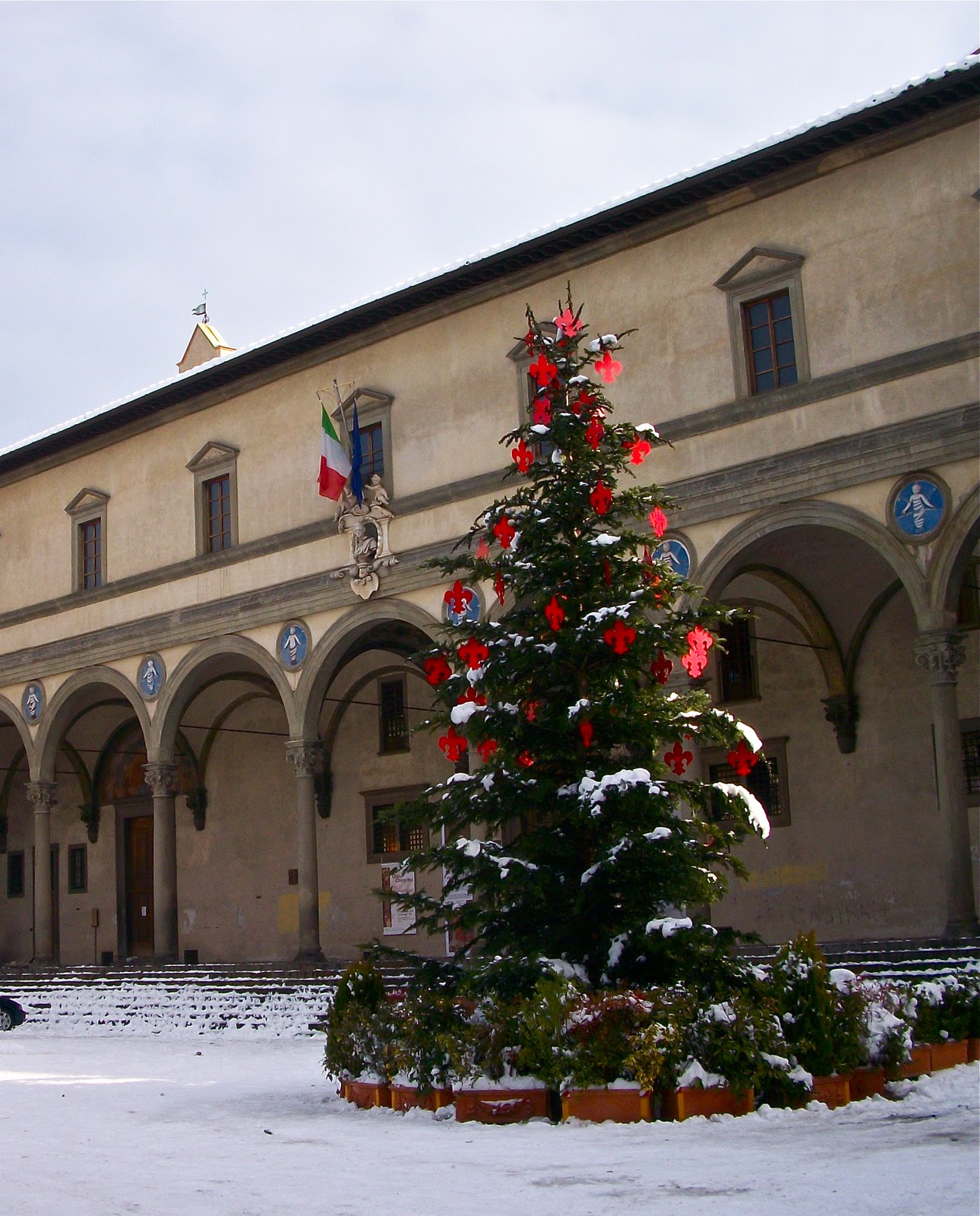 |
| Christmas tree outside Ospedale degli Innocenti |
Saturday, April 24, 2010
1300's DESIGN AT ITS BEST

I have always loved the Spanish chapel in the Santa Maria Novella Dominican convent. It is one of those places however that is rarely visited in Florence . I have always loved colour & busyness and maybe that is why I love it. I appreciate the organised space and the calm that pervades from Massaccio’s frescoes in the Brancacci chapel from the early Renaissance period in the 1420’s, but I just dig the 1300’s Gothic love for the horror vaccui (filling up of space), the naturalistic elements of the landscape, attention to minute detail, the elegance of the fabric & the awesome hell scenes with the devils who are often in shades of fuscia and red –and the Spanish chapel offers all of this.
It is pretty as well as being a massive visual overview of Dominican theology & church hierarchical structure.
Andrea di Buonaiuto frescoed the chapter house in the 1360’s, paid for by the Guidaliotti’s, a cashed up Florentine family who wanted to be buried in there with sermons said when they were in Purgatory. It earns it’s current name as it was given to the Spanish entourage of the Grand Duchess of Tuscany, Eleonara da Toledo, in the middle of the 1500’s.

All four walls are entirely frescoed & in fabulous condition. The wall opposite the entrance is where the cycle begins & is dedicated to Christ the saviour of mankind. Then comes the church militant & church triumphant with portraits of famous Florentines such as Dante, Boccaccio & Giotto, who mingle with the pilgrims and the Pope and the dogs of the Lord (a play on words of the Dominicans who are the Dominis canes or dogs / guardians of the faith). Then there is the Triumph of Christian Doctrine personified in Thomas of Aquinas, who is surrounded by the seven virtues, seven Liberal Arts & the seven Sacred Sciences. This scene underlines the Dominican’s intellectual role in the church. Finally the last wall shows scenes of St Peter the Martyr.
St Dominic, around at the same time as St Francis at the beginning of the 1200’s, had combatting heresy as his main aim. He was a very good preacher and soon gathered quite a following. He dispatched his followers to the cities in order to teach the true or orthodox view, as well as helping the poor. In order to be able to preach well and combat heretical views, the followers had to know theology in great depth and hence this particular order placed much emphasis on study and learning, which led to great libraries, schools & a principal role in the Inquisitions.
Symbolism, theology, beauty – the Spanish chapel has it all, so make room on your next jaunt to this side of the city.
Thursday, April 15, 2010
THE BIG CELLAR - THUMBS UP
Il Cantinone - via di Santo Spirito , 6/r tel 055-218898
I have been walking past trattoria Il Cantinone for years and finally I decided to descend into the ‘big cellar’ (translation of name) for a good Tuscan feed, which is what you expect to get as the black rooster (symbol of Chianti Classico, the most famous wine consortium in Chianti Tuscany) is displayed next to the name of the trattoria. In the end we didn’t eat a complete Tuscan dinner, but we could have done, I left very happy with everything - the food, the price & the great service.
I have been walking past trattoria Il Cantinone for years and finally I decided to descend into the ‘big cellar’ (translation of name) for a good Tuscan feed, which is what you expect to get as the black rooster (symbol of Chianti Classico, the most famous wine consortium in Chianti Tuscany) is displayed next to the name of the trattoria. In the end we didn’t eat a complete Tuscan dinner, but we could have done, I left very happy with everything - the food, the price & the great service.
Situated below street level, in an old cellar kitchen of the Capponi family palace, the fabulous raw brick vaulted ceilings date to the Medieval period and the atmosphere is relaxed & welcoming. The menus are cased in wooden folders, adding a nice touch to the rustic structure. The trattoria is owned by three brothers from Calabria, which may also explain the existence of other regional sauces thrown in for for diversity!
To start: a plate of grilled vegetables with bocconcini (little balls of buffalo mozzarella cheese) - excellent, a plate of spaghetti all’abbruzzese (Nduja & cheese) – excellent. To continue: Ossobuco with mushrooms & a side of spinach - excellent, finally, fillet of pork cinta senese with a strip of lardo di colonnata melted on top & placed on a bed of spinach – good.
House wine and water & the total price was 55euro.
As I was walking out, the cheesecake looked good but we had already decided that we had earnt gelato at our favourite place, all in the name of quality control, to make sure that it was up to the usual high standard!

CINTA SENESE – this is a native Tuscan breed of pig, the only one to have survived extinction. We can be sure that it has been around at least since the 1300’s, as it features in my favourite fresco from the 1300’s – the Good & Bad Government Cycle in the town hall of Siena . It has black hair with a white strip (from which the name derives, cinta = belt) & is leaner that most other pork.
LARDO DI COLONNATA – the most famous lard in the world! It comes from Colonnata, a little village in the mountains near Carrara, a stone's throw from the Tuscan coast, where the most famous white marble is quarried still today after centuries (used for David by Michelangelo). The secret to the great tasting lard is due to the six months curing process in the locally made marble vats, the quality of the product due to taking it from the back of the pig & the spices used. Sea salt is placed at the bottom of the marble vat (this will dry out the lard) & then, like making a lasagne, layers of lard are placed between layers of mixed garlic, herbs such as rosemary, spices and ground black pepper (the flavours are soaked up by the lard making it so yummy). They have been making it like this for centuries, the smart quarriers of Colonnata taking advantage of the primary resources surrounding them. It is the perfect thing to place over meat, or on warm toasted bread.
OSSOBUCO – braised veal shanks, a dish which originated in Milan. In Lombardy it is often served with risotto. Its name translates into English as ‘bone hole’ & indeed one of the tastiest things about it is eating the marrow in the bone’s hole!
NDUJA - this is a spicy calabrian sausage that is made from smoked pork, pepper, onion, wine & seasoning. It is made from using meat from head minus the cheek, other trimmings from the body and fatback (fat under the back of the pig). All of this is roasted with red hot peppers which makes it super spicy & delicious. You can buy this in a jar all mashed up and it is great to keep at home for when you get a take away pizza Margherita to smear on top of it!
NDUJA - this is a spicy calabrian sausage that is made from smoked pork, pepper, onion, wine & seasoning. It is made from using meat from head minus the cheek, other trimmings from the body and fatback (fat under the back of the pig). All of this is roasted with red hot peppers which makes it super spicy & delicious. You can buy this in a jar all mashed up and it is great to keep at home for when you get a take away pizza Margherita to smear on top of it!
Sunday, April 11, 2010
FLORENTIA: Ludi 'Games' panem et circenses 'Give them bread & circuses!'

Florentia, the name of the ancient Roman city of Florence founded between 30-15 B.C. under the first emperor Augustus, had a population of circa 10,000 people at its height of prosperity at the beginning of the second century A.D. It had a 16km long aqueduct bringing fresh water into the city from Mount Morello, public baths, a forum with splendid civic & religious buildings cased in marble, a thriving cloth industry, a theatre & of course an amphitheatre – a truly Roman building.
Unlike all the other things listed above, the amphitheatre was situated outside of the city’s walls. The amphitheatre (amphi - from Greek -means on both sides, or around, so the name indicates that the form is constructed by putting two theatres, in Greek meaning a place for viewing, together, thus forming an elliptic shape) was used only for blood sports or Ludi (games); animal against animal, animals & men together, gladiatorial fights & executions, and so it was therefore opportune to place them outside the walls.
In Florence, the roman amphitheatre was in the area of Piazza Peruzzi near Santa Croce. This was outside the walls of the ancient city as the street behind the Palazzo Vecchio, via Proconsolo, marked the Eastern city wall. Indeed, thinking of the topography in the area of the amphitheatre, one thinks of via torta (crooked street) so called as the buildings are constructed on top of the ancient ruins of the amphitheatre structure, and consequently the street curves in an elliptical form. Nearby, via Benticordi & the palaces in Piazza Peruzzi are all curved for the same reason.

The amphitheatre of Florentia could hold circa 20,000 spectators, accounting also for the population of nearby Roman Fiesole which, perched on a hill, didn’t have its own arena.
The Romans took much from the Greeks (art, politics, culture) but an amphitheatre was purely their own invention, both in form & in function. The Greeks didn’t know how to build the arch, thus explaining why they built their theatres always into a hill, so that the elevated tiered seating to watch the spectacle was achieved from the natural rise of the land. As their temples were usually on top of hills and hence, near to the theatres, the plays took on a decidedly moralistic and didactic undertone. Nor was it, in any case, in the Greek mentality to think of entertainment as a bloody fight between beasts & man.
The Romans, on the other hand, with the extensive use of the arch, were able to build aqueducts covering miles and so could build many colonies & then build theatres wherever they wanted on flat land, achieving height with the arch structure. But more important than theatre entertainment (which they viewed suspiciously fearing that it would make their men soft) they could build stadiums for blood sports, something they really sank their teeth into. The average Roman had no interest in theatre, he didn’t care for the deep & meaningful, he wanted games!
The biggest amphitheatre in the Roman world was the one in Rome, built by the Flavians (the rulers after the Julio-Claudians) at the end of the first century A.D. and dubbed the Colosseum in the medieval period. It is estimated to have a capacity of 50-70,000 people. Games were publicised like rock concerts today, the posters listed the lead up of events & they were free for all citizens and slaves. Tickets were necessary before the event in order to allocate seats which were assigned according to rank. They would often perfume the air to cover up the stench of blood and the arena floor was covered with sand (the word arena means sand in Greek) so as to better soak up the spilled blood and give a greater foothold to the combatants.
Blood sports in the amphitheatres were banned in the Empire at the beginning of the fifth century, however the next time that you are walking to Santa Croce don’t be alarmed if you hear a roar…..
Tuesday, April 6, 2010
CATHEDRAL 600 YEAR OLD CLOCK
 The clock on the counter façade of the cathedral often gets overlooked as, once inside, we immediately make our way towards the high altar. But this is one of my favourite things in here. It dates to 1443, was frescoed by Paolo Uccello and still tells the time correctly today, give or take a few minutes. In order to be able to tell the time, however, we need to know exactly how they told the time back then, at least on the Italian peninsula. They followed the hora italica or Julian time, as they had done in the Roman Empire, after the changes made by Julius Caesar to the calendar and time calculation. This was a 24 hour system with the day finishing at sunset and restarting as darkness set in, just as seeds grow first in the darkness of the soil, and the clock arm works its way through the hours counter clockwise, imitating the shadow of a sundial. It is adjusted about every two weeks, taking into account the changes in the length of the days. The French began to organise the time into 12 hours, starting from midnight, as we do today, and how the ancient Greeks had done, and this began to be slowly adopted in Italy from the 1580’s, after the adjustments to the Julian calendar under Pope Gregory XIII, with the Gregorian calendar. The Florentines changed the time system in 1750.
Monday, March 29, 2010
HAPPY NEW YEAR FLORENCE
 |
| The Annunciation by Fra Angelico in San Marco monastery |
In 1582 Pope Gregory XIII changed the calendar and made long overdue and much needed major reforms on the one mapped out by the ancient Romans and, indeed, today we follow the Gregorian calendar. Until 1582 all of Europe however followed the Julian calendar which Julius Caesar had implemented from 45BC after changing the time calculations to follow the Egyptian solar based calendar rather than the lunar based one they had been using for centuries.
Due to slight imperfections by the Ancients in the calculation, by the time we arrive at 1582, the days and the seasons no longer corresponded. Pope Gregory XIII ordered the major astronomers, scientists and mathematicians of the day to readjust the calculation of the year. In order to create order in chaos, it was necessary that the 4th October be followed by the 15th October, also making the first day of the year the 1st January.
 |
| Detail of the tomb of Pope Gregory XIII (in St Peter's Basilica) celebrating the introduction of the Gregorian Calendar |
Not everybody followed this new reform immediately. In fact, it took until the 1900’s to get everybody on the same page. Immediately after the papal bull was signed by the pope in 1582 the Protestants viewed it with suspicion and the poor viewed it as a cunning ruse on the part of the landowners to squeeze more rent money from them. In Florence the change of new year happened only in 1750 under the Grand Duke of Tuscany Francis Stefan (a plaque on the right hand wall of the Loggia dei Lanzi in the piazza Signoria reminds us of this). England followed soon after in 1752, the Bolsheviks in 1918 after the October revolution and Greece only in 1923!


Every year Florence continues to celebrate the traditional new year with a historical procession in costume in the afternoon which snakes through the centre finishing at the Santissima Annunziata church. Here the citizens of Florence pay homage to one of the city’s most venerated images of the Virgin Mary shown receiving the Holy Spirit along with the Archangel Gabriel.
 |
| Annunciation fresco by Friar Bartolomeo |
This painting of the Annunciation inside the Basilica dates to 1252 and it has been greatly venerated since it’s creation. The Annunciation fresco was commissioned to a painter called Bartolomeo who, after completing the archangel Gabriel, was so overwhelmed by the task of having to paint the beloved Holy Mary, decided to have a little nap in order to increase his energy levels for the impending job. When he awoke however, much to his astonishment, the fresco was finished!
The news of this miracle spread like wildfire and since then it has been one of the most important spiritual images of the city and a major pilgrim site for Florentines.
The news of this miracle spread like wildfire and since then it has been one of the most important spiritual images of the city and a major pilgrim site for Florentines.
 |
| Basilica of Santissima Annunziata |
The Basilica of Santissima Annunziata is, in any case, a church partial to the Virgin as it is of the Florentine order, the Servites – servants of the Madonna (the street that leads to the Basilica from the cathedral is called via dei Servi after them). This uniquely local order was created in 1246 after the Virgin appeared to seven Florentine noblemen who, in consequence, founded an order dedicated to her.
So tonight, go out for a prosecco to welcome in the new year Florentine style, after having passed by the miraculously angel finished Virgin housed in her beautiful silver coated chapel inside the Basilica Santissima Annunziata! Cheers and happy historical new year!
Subscribe to:
Posts (Atom)