Tuesday, June 21, 2011

IL MIO BEL SAN GIOVANNI

Ceiling mosaics of the baptistery


John the Baptist is the patron saint of Florence and his day of celebration is coming up very soon, on the 24th June, a public holiday for the Florentines. You can recognise St John the Baptist in visual imagery as he is depicted as an ascetic, typically wearing a camel skin and holding a staff. He is often holding a scroll (reference to he being the last prophet) with the words ecce agnes dei often written, the words he pronounced upon seeing seeing Christ ‘behold the lamb of God’. He was the son of Zacchiarias and Elizabeth, the older cousin of Mary, making Christ and John second cousins and it is traditionally held that there are six months between them in age, John being slightly older.
The baptistery of Florence is situated over the remains of a wealthy Roman house during the time of the Latin city Florentia in Antiquity. This family paid extra taxes for fresh water to be brought to their home from the nearby aquaduct in order to have a private bath structure. The baptistery was later built on top of the ruins of their dwelling, conveniently using the already existing channels of fresh water, the fundamental element in sacred rites symbolising the washing away of original sin, and water being the traditional symbol of the giving of life. The mosaics from the floors of the Roman house are still visible through a grate on the floor of the baptistery.
John the Baptist by Leonardo da Vinci
The early Christian structure was replaced with the current magnificent Romanesque style building in the eleventh century when Pope Nicholas II, a Florentine, supported the funding. The Romanesque style, characterised by the round headed arch and a compact sold structure, is given a particular individualistic trait in Tuscany with the geometric patterns and decorative format of the green and white local marble. Moorish inspired, this decorative use came through the great maritime republic of Pisa which had the means of seeing many Islamic buildings. Symbolically, it is octagonal in structure as in Christian numerology it refers to the eighth eternal day after the seven earthly days and the figure eight, when placed on its side, becomes the symbol for infinity.
Visitors to Florence often skip a visit inside the building - wrong! It is wonderful: the mosaics on the ceiling, begun in the early 1200’s, are stunning. The intricate detail given to the stories from the old testament from creation through to the story of Christ are delightful and the Last Judgement representation is up to its usual imaginative medieval genius.
Not the biggest baptistery in Italy - size was a serious display of importance - as Pisa beats it, I believe, but certainly it is worthy of the epithet  'the most beautiful'. Considered thus for centuries, Dante refers to it as 'il mio bel San Giovanni', and we can't argue with him. It is still used for baptisms, on the last Sunday of every month as long as you are Florentine!
The octagonal Baptistery of San Giovanni
Happy Saint Day John! 

Thursday, June 16, 2011

CAFFETTERIA DELLE OBLATE


Have a light lunch or a drink in one of the coolest gems in Florence - it's neither chic nor fancy, but local, historical and tranquil, and Brunelleschi’s dome feels so close it's almost as if you can touch it!  It's the cafe on the top floor of the public library on Via dell’Oriuolo 26, situated behind the cathedral. The library and cafe are inside an age old structure which once had quite a different purpose. This was the nucleus of the hospital founded by Folco Portinari (the father of Beatrice, Dante’s muse) in 1285. The female nurses, a religious group called oblate, were housed on this site and the church connected to the hospital was called Santa Maria. Shortly afterwards, a male equivalent was begun across the road and called Santa Maria Nuova, which still exists today as the main hospital in the historical centre of Florence. The original space (now the library complex with the coffee bar on the top floor) was left for the female convent. I have always loved Italy for the way that the old is reinterpreted into the new, and this is a perfect example. The centuries old structure now houses the council library and is always full of students. The top floor is where this little bar is located and the rest of the space has tables and chairs where friends meet and chat, use their computers and/or read. It is a wonderful little respite stop to remember when passing through the city or living in it, as I do.
 In the evenings they do a Happy Hour aperitivo which costs 8 euros and there is a little accompanying buffet. The bar is open according to the schedule of the library, closed Sunday, open Monday 2pm-7.30pm, Tuesday-Saturday 9am-midnight.


Friday, June 3, 2011

OSPEDALE DEGLI INNOCENTI


Ospedale degli Innocenti
Florence is the home of the first orphanage in the world. A structure entirely dedicated to the care and maintenance for the foundlings, or the ‘Innocents’ of the city. In the early fifteenth century two of the six hospitals  (San Gallo and Santa Maria della Scala) took care of the orphans, but only as part of the greater care that they offered to all sections of society. In the Piazza del Duomo, the Misericordia (Society of  Mercy) and the Society of the Bigallo provided hospitalization for the foundlings, but not  the raising of these numerous children of all ages abandoned in the countryside and the city. In 1410 Francesco di Marco Datini, a very wealthy merchant from Prato (the nearest town to Florence) left a considerable sum of money in his will to Santa Maria Nuova hospital in Florence in order to create a specific section for the care of orphans. He had already created a similar 'section' in his hometown and wanted to inspire the Florentines to do the same. After much discussion and little action over many years, it was decided to create a whole separate structure, not attached to the hospital, but an orphanage, dedicated to the care, education and well being of the Innocents of Florence and surrounding territory. Land was acquired from a wealthy family, the Albizzi, in the present Piazza Santissima Annunziata and the silk Guild (one of the seven major merchant guilds) was entrusted with the responsibility of being patrons for the entity. Filippo Brunelleschi, now hailed as the first renaissance architect, was commissioned the construction of the Ospedale in 1419. His structure is one of the first buildings built in the new Renaissance style, based on a modular design creating a structure of proportion and balance – a perfect ambiance for little ones to grow in security and safety after their traumatic beginning. 
The first orphan entered on 5th february 1445. She was called Agata Smeralda. By 1468, there were 400 orphans being fed outside the institution and 300 in the hospital. In 1553 there were 2000 mouths to feed -  the babies nursing, the weaned ones and the older boys and girls. Many of the nameless were given the surname Innocenti, a common surname in Tuscany today.
Window in loggia where babies were left
Under the famous front entrance loggia of the Ospedale, an almost iconic symbol of fifteenth century Renaissance architecture, is where the babies were left by their parents when unable to offer care. Initially they were left in a marble basin sheltered in an enclave in the wall of the loggia. Later, they were placed through an iron grated window, still visible today, built into the left side wall of the loggia. The babies were passed through the grate and placed in a basket on the other side. Some babies had distinctive objects attached to their wrist, around their neck, or a particular item of clothing, often halves of something, so that if the parents came back to retrieve their children they would be identifiable. These items (coins cut in half, particular symbols on necklaces etc.) were noted down by the head foster mother (in Italian: a soprabalia). In the museum on the second storey of theOspedale there is a little glass display case with some of these ‘markers’. 
The Madonna by Domenico del Michelino
Also in the museum are some beautiful paintings commissioned to some of the most important painters of the day for the orphanage’s church, Santa Maria degli Innocenti. The superb ‘Adoration of the Magi’ (1488) painting by Domenico Ghirlandiao was on the high altar, and a beautiful enthroned Madonna and child (1493 ca.) by Piero di Cosimo, commissioned by Piero del Pugliese, an extremely wealthy silk merchant in the city, for his private family chapel inside the same church. There is also a canvas painting by Domenico del Michelino of the Madonna (1440 ca.) holding her cloak out wide protecting the foundlings gathered around her. This, it is thought, could have been used as a processional banner.  In the foreground, the littlest ones are swaddled and in the background, the older ones are wearing the black cloth uniform of the orphanage with their badge, a swaddled child, attached to the front. The building today has medical services for children, a day-care centre and offices for UNICEF, as well as this very fascinating little museum.  Check it out!  Open Monday – Sunday, 10am-7pm, admission fee: 5euro.
Adoration of the Magi by Domenico Ghirlandiao

Saturday, May 28, 2011

COFFEE COOL


I recently did a tour for a great group of Aussie high school teenagers. 
When speaking with their lovely (and cool) English teacher who was accompanying them through Europe, she told me an amusing story. When they were in Rome, she would start each day with a coffee in a local bar. She told the students that they should come with her as it would be a perfect time to write in their journals, something that they had to do in any case at some point each day as part of an assessment. She told them that it was a good place to experience Italian life. Initially, the teenage boys weren’t overly keen and the first few times they went reluctantly -  coffee was something older people drank and was maybe even a bit of a sissy drink, so the whole thing was a bit naff, the opposite to a pub and beer. That was until three uber cool young Roman guys rocked in one morning to the café where they were, helmets in hand for their vespas, that they had casually, and probably illegally, parked outside, sporting cool sunnies and decked out in the ubiquitous Diesel jeans and some cool and, no doubt, snugly fitting tops. They ordered three macchiato coffees, laughed and joked with the barman and with each other, drank them, paid, and then sauntered out, all in the space of about five minutes. The English prof noticed that the three male Aussie students were mesmerized, and, early the next day, they asked when they were next going to the coffee bar. On arriving at the bar, all three ordered a macchiato!   

Un caffè -  an espresso, a shot of coffee in a small cup. 
Un macchiato means ‘stained’ (it is the past participle of the verb ‘to stain’, which is macchiare) -  served in an espresso cup, the shot of coffee is stained with a dash of milk. 
Un cappuccino -  so named for the colour of the milk coffee which resembled the 
habit of the cappuccin friars ( a branch of the Franciscan order who wear a lighter brown greyish habit).
Un caffè americano -  is a shot of espresso served in a cappuccino cup with hot water added. If ordered when seated it will often be served with a little jug of milk. If ordered at the bar standing there should always be a little jug of milk. If there isn’t, then ask.
Un marocchino means Moroccan -  a shot of espresso in a small glass cup 
filled to the top with milk and cocoa added on the top as well as in between the 
milk and coffee. (this is not diffused in all areas of Italy). 
Un caffè corretto means a corrected coffee - an espresso with a shot of grappa. This could be good for suffers of Stendhal syndrome in Italy, a replacement for smelling salts to regain composure! 
There are two different price systems in the coffee bars, the price differing according to whether you sit or stand at the bar (what Italians do). If you stand at the bar, then you pay before at the cash register and take the receipt to the bar, give it to the barista and tell him what you want. He will rip your receipt and serve you your coffee, which you consume standing at the bar. If you sit at the table, somebody will come and take your order and bring you a bill. The price goes up according to  the service charge. Beware - it can sometimes triple, especially for seating outside in the piazzas. Prices are listed in the menus on the tables.  
Italians drink cappuccino at breakfast time, until mid morning. Then they switch to a macchiato or an espresso for the rest of the day. They find the Anglo-Saxon habit of a cappucino after dinner truly puzzling.  It is all about mixing too much milk with digestion, which could cause havoc!  Instead, they have an espresso, or even better, a digestivo (something like Montenegro) - or better still, both! 
Favourite coffee places in Florence: 
Chiascuro
Cafe Giacosa Roberto Cavalli

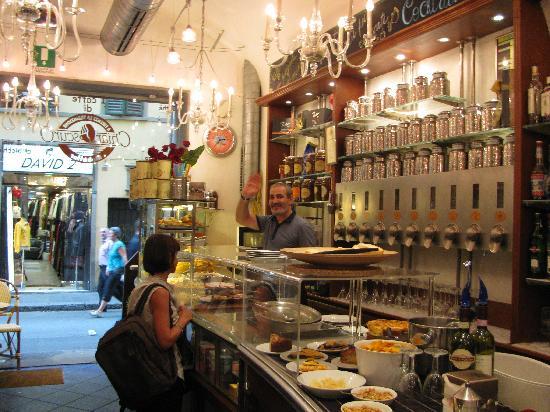
Cantinetta dei Verrazzano in via dei Tavolini - I must admit that I have coffee here every day. It is very good, they are very nice and the cakes, pastries and 
focaccias are also very good. The benches and table tops are of Carrara white 
marble which adds to the   atmosphere of eternally good things… 
Café Giacosa - Roberto Cavalli, next to the Cavalli store on via Tornabuoni - here the good coffee is always served with the addition of liquid chocolate, so 
Café Giacosa inside Palazzo Strozzi on via Tornabuoni -  run by the Caffé Giacosa mentioned above and is a lovely place for good coffee, cake or light lunch. Never too crowded and seating in the internal courtyard. 


Chiaroscuro in via del Corso - serves good coffee with yummy variants that are written up on a board above. A friend of mine always orders a marocchino here…….

Cafe Giacosa Palazzo Strozzi

Sunday, May 22, 2011

GIROLAMO SAVONAROLA - THE FRIAR WHO PLAYED WITH FIRE

 Girolamo Savonarola by his follower Fra' Bartolomeo
The Dominican friar Girolamo Savonarola, originally from Ferrara, was hanged and burnt in the Piazza della Signoria in Florence on the 23rd May 1494. Every year, on the morning of the anniversary of his death, there is a renaissance parade from the Palazzo della Parte Guelfa to the Piazza della Signoria, where a wreath is laid over the plaque which marks the spot where the burning took place. Savonarola died, along with two of his most ardent followers, in the same square where he had held the infamous 'Bonfire of the Vanities' during the period of Lent in 1497 and 1498. Non-Christian books and art (drawings and paintings), and objects of earthly passion and distraction, such as cards, precious fabrics, make-up and wigs, were burnt in the square on a platform made of seven steps, symbolising the seven vices. Savonarola was an extremely influential preacher who called for great reforms of the church which provoked anger from the pope at the time, Alexander VI. 
In 1491 he was made prior of San Marco monastery in Florence and began to preach in the cathedral. With the expulsion of the Medici family from Florence in 1494, due to a sharp decline in popularity after the death of Lorenzo the Magnificent de Medici and the incompetence of Piero de Medici, his son, to gain support from the people, Savonarola filled the power void and substituted humanist thought and neo-platonic philosophy with a theocratic government and an austere religious atmosphere for four years. Savonarola reorganised the government and, inspired by the Venetian model, increased political representation to 1500 people. He then commissioned an extension to the town hall, the 'Salone del '500' (Room of the 500), where the newly enlarged government could meet, in three sittings of 500 people at a time, giving name to the room. He referred to it as the Hall of Christ. 
His sermons increased in religious fervour and he claimed that Christ was speaking through him, he being a prophet of Christ. He attacked the papacy, who initially offered him a cardinal's hat to silence him, which he rejected, before excommunicating him. Cesare Borgia, the head of the papal army and the pope's son, came to Florence where a forced confession was taken from the friar, followed by his death in the square. 
Due to the austerity and fanatical nature of his reign, opposition had grown in Florence. The opponents of Savonarola, dubbed the Arrabbiati (Angry Ones), called the Dominican's closest followers the Piagnoni (Wailers) as they complained incessantly and spoke endlessly of the end of the world. After Savonarola was burned, his ashes were gathered and sprinkled over the Arno to avoid them being collected and kept by his believers, although the cult of Savonarola continued throughout the sixteenth century. 
Savonarola's cell in San Marco, Florence
Visitors to the beautiful San Marco monastery can enter his cell where many of the sermons would have been written and can see the bell that called the Florentines to hear him speak. This bell was exiled to outside the walls, to the dreaded enemy of the Dominicans, the Franciscan church San Salvatore al Monte, after his death. A few years later the Gonfaloniere Pier Soderini, head of the Republic, in an act of clemency, returned the bell to the Dominicans.
The hanging & burning of Savonarola in Piazza della Signoria - an anonymous painting from 1498 in the Museo di San Marco


Sunday, May 15, 2011

Lions and tigers and bears... oh my!


Room after room of the fantastic creations
that roam the earth.
 

Anotomical models in wax made
between 1770-1850.
 
La Specola, the oldest science museum in the world, should be the newest addition to a visitor’s Florentine itinerary. Opened to the public in 1775 by Grand Duke Pietro Leopoldo (of the Hapsburg-Lorrain family, who ruled Tuscany the Medici and Unification), it was initially the seat for the all the science museum categories (zoology, mineralogy, scientific instruments, astronomy, anthropology, geology etc.). Over the centuries these separate scientific disciplines have been separated and spread around various different seats in the city and the museum now houses only two main sections of the magnificent scientific collection in Florence, but possibly the most fun, the zoological collection and the unbelievable wax anatomical models. The name of the museum, La Specola, means Observatory, as that was what was built on top of the Palazza Torrigiani, the building where the museum is located. The Observatory was later moved to Arcetri (behind San Miniato al Monte church more or less) but the name remains. La Specola museum is comprised of thirty-four rooms, the first twenty are dedicated to the Zoological section, organised according to animal categories such as fish, birds, mammals, reptiles, etc. Afterwards follows thirteen rooms dedicated to the intricate and precise anatomical models made out of wax created between 1770-1850, initially commissioned by Grand Duke Pietro Leopold, to be teaching and study aids, replacing real cadavers. Each room concentrated on a particular part of the body area and the models are accompanied by intricate drawings of the same body part or organ in frames above. It is a fascinating, fun, strange and a completely underrated place in Florence. Open: 9.30am-4.30pm, (6euro admission fee, reduced 3euro). Closed Monday, address: via Romana 17.

Sunday, May 1, 2011

ITALIAN EASTER: IT'S NOT ABOUT THE CHICKEN OR THE EGG, BUT THE EGG, THE DOVE & THE PASTIERA!

La colomba pasquale / the  Easter Dove
During this past Easter, I discovered yet another regional speciality. The pagnotta (left), made only during this Christian celebration, originated  from a little place called Sarsina (province of Forlì/Cesena), in my beloved area of Romagna (north of Tuscany). It is a slightly sweet, light bread with a small quantity of raisins inside. To be honest, I wasn’t mad for it – it was a little unexciting, but what I love is that Italy always makes me feel a little like Alice in wonderland. Italy, like nature, always dishes up something new in different parts of the year and in different areas. The Italians have always rivalled nature herself in art, so it makes sense that they would do so in food also. The pagnotta was nicer when I dunked it in milk and when I ate it with the boiled eggs that Italians traditionally eat at breakfast on Easter Sunday. 

La Pagnotta - Sarsina
The national Easter cake, something for which I do however have great affection, is la colomba pasquale – the Easter Dove (above). It’s like a cousin of the panettone in taste, and indeed it was first made at the beginning of the 1900’s in Milan by the company Motta, already one of the established panettone companies. The difference, however, is that it is in the form of a dove, symbol of peace and rebirth, just like Easter eggs. Like the panettone, the main ingredients are flour, sugar, butter, eggs, and yeast with small pieces of candied fruit (orange and lemon), with the addition of almonds and hard sugar pieces placed on top. La colomba is eaten most often on Easter Sunday after the big lunch.

The Florentines (and those in the surrounding area) however, not being able to wait for the sweet dove to swoop down and break their fasting of all tasty treats on Easter Sunday, created some chocolate biscuits, called Quaresimali (the word Quaresima means Lent – so they are called Lent biscuits), that one is permitted to indulge in during the normally restrictive Lent period, the 40 day period between mardi gras and Easter (below). Nuns near Prato are thought to be the creators of these chocolate biscuits, in the form of the letters of the alphabet, representative of the bible text. Their dark brown colour from the cocoa is symbolic of the ink used to write the word on the paper. Being symbolic of the sacred Christian text, they are permissible during the period immediately before Easter. Indulging in chocolate biscuits, and lots of them, is even given a sacred spin in Florence!

Quaresimali - Florence

Finally, I must conclude with a mention of one of my favourite cakes in Italy, the Pastiera, traditional around Easter time in Naples. It is spectacular, a pastry base with a lattice top and a filling to die for, made with wheat kernels (its origins have pagan roots as it was historically made to celebrate the beginning of Spring), ricotta, orange flower water, eggs, sugar, pastry cream and diced candied fruits. Crazy, but oh so heavenly.
La Pastiera - Naples