Sunday, January 22, 2012

THE BATTLE OF THE BACCALA

Baccala or salted codfish
One of the many loves that I have developed and nurtured since moving to Italy is baccalà. I get very excited every time I see it on the menu, especially as it is dished up and cooked in a variety of different ways depending upon the region. For most Italians, baccalà is salted codfish, except for the biggest consumers of this imported white fish, the Italians from the Veneto region, where the word baccalà is for unsalted codfish, this being referred to in all other areas of Italy as stockfish. Thus in Italy, baccalà is the word referring to the same fish, however, it is typically unsalted in the Veneto (stockfish to all other Italians) and salted to all other regions, such as in Tuscany.

Imported to Italy from the fifteenth century initially through Venice, baccalà  is still today a daily feature in the diet of the Italians from this region, whereas in Florence it appears on the menus typically on Fridays only. One commonly told story recounts that the importation of this versatile fish to Italy dates to 1432 when the Venetian captain Pietro Querini and his crew were shipwrecked on the island of Rost, south of the Lofoten islands off Norway, and to survive they fished and ate the local stockfish, known as baccala, which they continued to eat after returning home.

After the Italian, John Cabot, discovered Newfoundland in 1497, the greater trade routes of cold Atlantic seas made for much greater importation and from the sixteenth century onwards, codfish became continually more widespread in Italian cuisine. It is cheap and the two different preservation procedures used, air drying and salting (similar to that of prosciutto), meant that it was accessible to the poor and was able to be used on Fridays for inland towns when fresh fish wasn’t available.

Salted baccala at the Sant' Ambrogio Market in Florence on Friday, ready to cook. 
The fisherman splits the three to six foot long cod along the belly and discards the backbone, leaving a small portion above the tail. For the salting technique, the codfish is then heavily salted and tightly stacked in many layers. As the cod’s salt bearing cells begin to erupt in reaction to the salt, the liquid is removed and more salt is added. This process continues for about ten days when the water content is under 40% and the fish can be preserved for up to one year. When used for cooking, it must be soaked for up to 48 hours, to rehydrate and remove the percentage of the salt content. The soaking liquid should be changed at least three times during the 48 hours. For the air drying technique, the codfish is immediately treated after being caught and put on supports and left in the open air from February to May. The cold and dry climate, typical of the Scandinavian area, is perfect for this process.  With a temperature ideally below zero it protects the fish from bacteria and insects. After the three months out in the open, it matures in a dry and well ventilated area for a further two to three months. After this process the codfish has lost 70% of its water content but retains most of its nutrients. It is rich in protein, iron salts and calcium.

Baccala mantecato, also called baccala alla veneziana or ‘Venetian style’, is one of the things that I hold close to my heart. The rehydrated air dried codfish (stockfish) is mushed up and mixed with anchovies, oil and milk to form a paste (looks a bit like dense cottage cheese) and then spread in abundance on grilled polenta, or a crostino (small baguette slice). You can find this in the many baccaro bars (traditional tapas like bars in Venice) scattered around the city, and it is a perfect little snack when you meet your mates for an ombra (the Venetian word for an aperitif), ideal at anytime during the day.

Baccala mantecato
Baccala alla vicentina, ‘Vicenza style’, is also stockfish (air dried codfish) and the fish is kept in large flakes or small bite size pieces and prepared with similar ingredients as in Venice. It is eaten more often as a meal and served with soft polenta. 

Baccala alla vicentina
In Tuscany, on Fridays, in local trattorias, baccala alla livornese, Livorno style, will be very often on the menu. In fact, you can find already unsalted baccalà at the local food markets on Fridays so that families can cook it easily at home, avoiding the time consuming de-salting process. Livorno is the largest port in Tuscany, and the way that the Tuscans eat the salted cod is in a fillet, pan-fried, with peeled fresh tomatoes, parsley and garlic.

Baccala alla livornese
Baccala alla romana, Roman style, is deep fried, it is also called baccala fritto alla giudia, fried Jewish style, referring to its possible origin from the Roman Jewish ghetto. There are still some little traditional local bars in Rome, one just off the campo dei Fiori in the historical centre, which cooks this as a snack, and it also features often on the menus.

Baccala alla romana


In Venice I recently had a fabulous plate of baccala mantecato and baccala alla vicentina as a starter in the restaurant 'Antica Adelaide' situated in the Cannaregio area.  The menu here is predominately Venetian cuisine. 
My favourite baccala alla livornese to date in Florence is at 'La Casalinga' near piazza Santa Spirito, made on Fridays only.  If you are keen on trying it, aim to go at lunch time as there may not be any left by dinner time!

Saturday, January 14, 2012

CLIMBING THE SCAFFOLDING IN SANTA CROCE TO LOOK AN ANGEL IN THE EYE

Detail of one of the Agnolo Gaddi frescoes recently restored above the high altar of Santa Croce.  Previous filling of the cracks has been removed and will not be replaced as it damages the fresco further by altering the colours.
Seeing fourteenth century frescoes centimetres away is pretty special, but seeing them many metres up from the ground on the restorers' scaffolding, and being able to touch the ceiling, is a rare and fascinating experience. In an instant role-reversal, we are no longer merely the spectator but it is easy to imagine being the artist, and we are privy to all the little details that the workshop included, details that are missed when seen from a ‘normal’ viewing point, down below.

The cleaning and conservation project of the high altar frescoes, covering 900,000 square feet, in the main Franciscan church called Santa Croce in Florence, started in 2005, and scaffolding has blocked entry and viewing since then. This huge undertaking was financed by a private Japanese businessman, Mr. Kamazawa, who donated two million euros.  The restoration was carried out by the Opificio delle Pietre Dure, a centuries-old Florentine workshop of international repute, devoted to restoration since the nineteenth century. The major part of the work on the frescoes has finished, however the scaffolding will remain until next June whilst the restorers monitor their work. They are also now cleaning and restoring the fourteenth century wooden crucifixion by the Master of Figline which usually hangs above the same high altar. The crucifixion is laid horizontally on a table on one of the many ‘floors’ made from the scaffolding.

The Opera di Santa Croce, the administrative body of the Santa Croce church complex, offers guided tours on the scaffolding, in both Italian and English, twice daily to see the frescoes and explain the story that they depict.  Silvia, my guide, talked us brilliantly through the frescoed scenes and answered my endless questions about the recent works. The tour lasts approximately 45 minutes to one hour and, at a cost of 10 euros a person, it is worth every penny. Tours will definitely run until Spring this year and possibly until June, the estimated time when the high altar is planned to be revealed and returned once again to the church.
The Franciscan church is dedicated to the holy cross of Christ, and the high altar frescoes, executed between 1380-90 by the Florentine artisan Agnolo Gaddi and his workshop, depict the history of the cross of Christ, from the very origin of the tree from which the wood of the cross was constructed, to its fate after the crucifixion of Jesus. Saint Francis of Assisi was particularly dedicated to the cross, symbolic of the suffering that Christ endured for the saving of mankind and his life. Francis earned the appellation Alter Christus due to the similarities between his own life and way of being and that of  Christ. He, like Christ, renounced worldly possessions and advocated a life of obedience, chastity and poverty (these virtues are symbolically represented by the three knots in the rope around the waist of the Franciscan habit). 
In 1224, two years before his death, he was the first Christian to receive the stigmata, the transversal of the five wounds that Christ received on the cross, symbolic of Francis’ elevated faith, holiness and reverence of Christ. Considering the mystical association of Francis and Christ with the stigmata, it is not surprising that a Franciscan church is dedicated to the Holy Cross.
A restorer's view of Gaddi's fresco cycle

The story of the wood used to make the cross is wonderfully dramatic. It’s very origins are contemporaneous with the origins of man himself. The history of the cross is narrated, at length, in the bestseller of the mid-thirteenth century, The Golden Legend, by Jacopo della Voragine, the bishop of Genoa and a Dominican friar.  His compilation of religious stories and hagiographies became a ‘must read’ for centuries. 
The first episode at Santa Croce depicts Adam’s death when his third son, Seth, put a branch from the Tree of Good and Evil, given to him by the Archangel Michael, inside the mouth of Adam before burial. This branch grows into a beautiful tree and when King Solomon was building the temple he ordered that the magnificent tree be chopped down so as to use the wood. The wood, however, proved to be too tough to work, and so instead was used to bridge a river. The Queen of Sheba,  crossing this river en route to meet the famous Solomon,  had a vision from God of the future use of the cross and told Solomon when she arrived in Jerusalem. Solomon, knowing that the wood would later be used for the cross of the man who would change the course of history for his people, buried it. Centuries after the crucifixion, Helena, the mother of the Roman Emperor Constantine, was determined to find the cross. She succeeded after much searching and more adventures. It would then be stolen, fought over, and returned to Christian hands, divided up and scattered throughout Christendom.

The construction of the True Cross
Another elaborate cycle of the cross in Tuscany, frescoed in the following century, is in another Franciscan church, San Francisco, in Arezzo, by the great fifteenth century artist, Piero della Francesca.


Discovery and proof of the True Cross by Piero della Francesca in San Francisco, Arezzo. Note the beautiful depiction of Jerusalem beyond the hills which is, in fact, Arezzo with its many coloured buildings enclosed by its walls.


Saturday, January 7, 2012

THE EPIPHANY – FLORENCE’S KINGS

Adoration of the Magi, Filippino Lippi, 1496, oil on panel, Uffizi gallery, Florence.
The Epiphany is celebrated on the 6th of January in the Christian calendar, the day dedicated to the adoration of the Magi of the newborn Christ baby. This was an event celebrated with magnificent pomp and ceremony in fifteenth century Florence. The word Epiphany comes from the Greek, meaning ‘manifestation’ and refers to the physical manifestation of God the son as a human being to the Gentiles, the three wise men. They bring gifts to the Christ child which reflect their understanding of his dual nature; gold, frankincense and myrrh, as symbols of Christ’s regality, sacredness and death, respectively. Over time, the wise men developed more individualised and elaborate symbolism.  Casper, Balthazar and Melchior were often represented as the three main ages of life, and of three ethnic backgrounds.

Adoration of the Magi,  Andrea Mantegna, 1495-1500, oil on canvas, Getty Museum, Los Angeles.
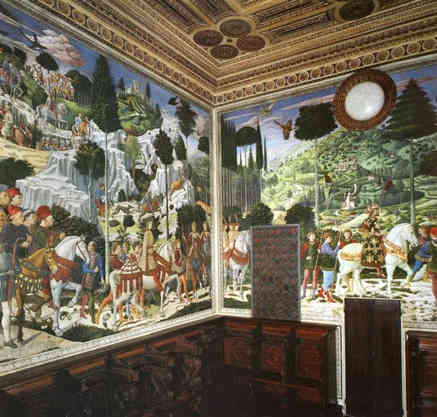
If figurative representation is taken to be an indication of popularity, there were few other cities in Italy which gave such importance to the 6th January, so many are the paintings of the Adoration of the Magi in Florence from this period by some of the greatest artists, commissioned by some of the most important families. The most spectacular example of the subject is the frescoed chapel in the Palazzo Medici-Riccardi by Benozzo Gozzoli in 1459-60, commissioned by Piero the Gouty de’ Medici.

Detail of the back and left wall, when looking at the altar, of the private chapel in the Palazzo Medici-Riccardi.
Frescoed by Benozzo Gozzoli 1459-60, commissioned by Piero the Gouty de' Medici. 
The date of the Epiphany held even more importance for the Florentines, as it was also the day which John the Baptist, the patron saint of the city, would baptise his second cousin in the Jordon long after the Magi had visited him. This event is now celebrated in the Western church eight days after the Epiphany, on January 13, but in the Orthodox church it is celebrated on 6 January.

A Florentine lay confraternity dedicated to the three wise men (who over time become represented as kings with ever increasing symbolism) staged a re-enactment of the their journey to find the new born Jesus, the King of Kings, every few years. The confraternity was in existence from 1390, the earliest documentary evidence, when the pageant was recorded by a by-stander. It was dissolved with the expulsion of the Medici family in 1494, the ruling family being one of the longstanding active patrons of the confraternity.

2012 re-enactment of the Magi procession
The Compagnia dei Magi, staged a spectacular re-enactment of the story, using most of the city as the stage, every few years. A chronicler recorded that there seven hundred costumed men in the 1429 pageant. Herod’s palace was at the San Romolo church in the piazza della Signoria (now where Rivoire cafe is located), and then the hundreds of horsemen (the entourage for the Magi), and colourful floats with mini skits connected to the history of Florence, such as David and Goliath, make their way to Bethlehem, recreated in piazza San Marco. From the cathedral square or canto di San Giovanni (canto means ‘corner’) along the via Larga (now via Cavour) finishing in San Marco, the street was lined with grandstands, benches and boxes decorated with bunting, rugs and backing.

The pageant didn’t follow a precise route every time, nor a fixed narrative.  In the 1419 pageant, after the Magi visited Bethlehem they came back to the cathedral square where the Massacre of the Innocents was staged. So great and spectacular was the parade, the Compagnia de’ Magi were also called on by the Signoria (the government of the Republic of Florence) to stage re-enactments in times other than the Epiphany. One such time was in 1439, towards the end of the great ecumenical council that Florence had been hosting for the past few years. The most important leaders of the Orthodox and Western churches, their entourages and intellectuals, were all in the city. The splendid Festa dei Magi was included into the Festa di San Giovanni, the week-long festival held for St John the Baptist, the city’s patron saint. 

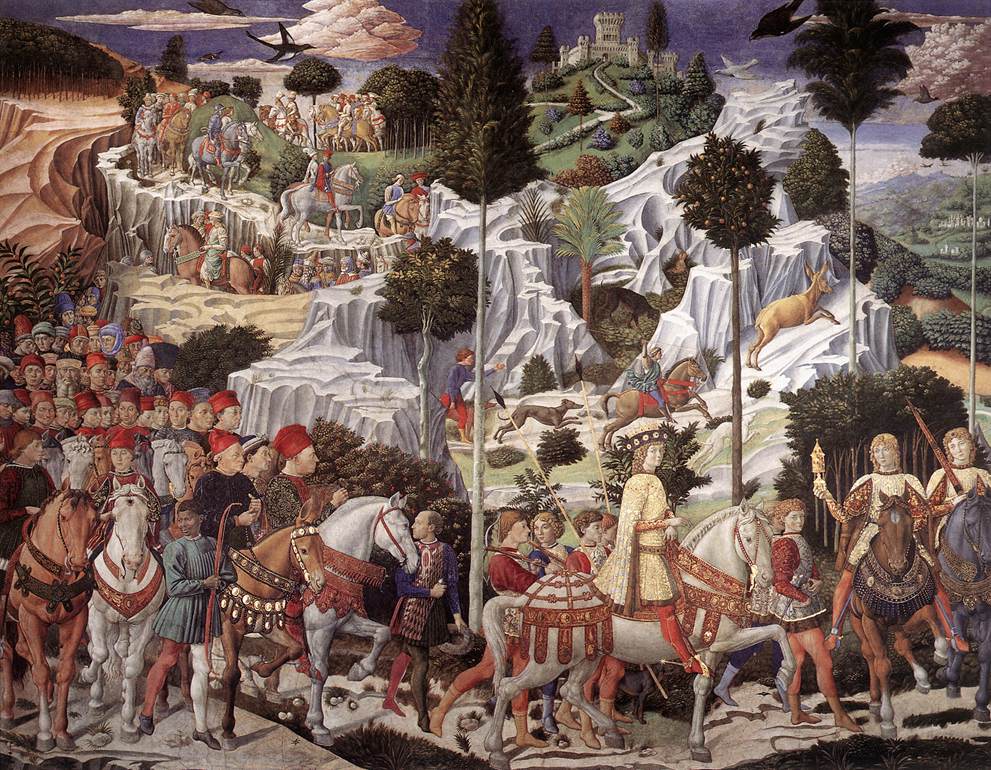
For four generations, the Medici capo di famiglia (head of family) were members of the Compagnia de Magi. In the 1459 pageant, the future Lorenzo the Magnificent, then ten years old, was an active participant. The subject was chosen by his father as the decoration of the chapel in their nearly completed Renaissance merchant home. This was the first private chapel in a private home in Italy. The underlining message here was that the Medici family were the kings of Florence in all but name and the republic was something of the past. The fresco was exquisitely executed.  Benozzo Gozzoli had trained under the sublime Dominican Observant friar, Fra Angelico in the San Marco monastery years before, another Medici funded project. The colours have a jewel-like quality and the costumes have a tactility about them that makes you want to reach out and touch them . 

Detail of the back wall in the Medici chapel, Balthazar, Benozzo Gozzoli, 1459-60, fresco, Palazzo Medici-Riccardi. 

A Magi is depicted on each wall with their accompanying entourage.  These are like the social pages of Hello! Magazine, the leading allies of the Medici family, both domestic and foreign, clearly discernible. The background is similar for all three, a running landscape with lush green hills, prime for hunting (a favourite pastime of the family), dotted with castle-villas.

Detail of right wall when facing the altar, Melchior and entourage, Benozzo Gozzoli, 1459-60, fresco, Palazzo Medici-Riccardi. Portrait of Cosimo the Elder dressed in black riding a donkey behind the Youngest Magi, his son, Piero the Gouty, to the right on a white horse. Riding a horse in the far left corner is Sigismondo Pandolfo Malatesta, Lord of Rimini, and next to him is Galeazzo Sforza, intended future ruler of Milan.  
They too all arrive, prima o poi (sooner or later), at the Christ baby to adore him, a Filippo Lippi Madonna and child (now replaced with a copy, the original is in Berlin).

Adoration of the child,  Filippo Lippi, 1459, tempera on panel, Gemaldegalerie, Berlin. 

Thursday, December 29, 2011

WINING & DINING WITH FRESCOBALDI

The little wine bar section of the Frescobaldi restaurant, entrance from via della Condotta. 
The other day I dined for the first time at the Frescobaldi restaurant in central Florence, a stone’s throw from the town hall square. It was delicious and it has now been placed on my list of fave choices for places to eat in the city. A fabulous menu, my first course was spaghetti al burro cacio pepe e rigatino (spaghetti with pecorino grated cheese, cracked pepper with unsmoked bacon bits), 


followed by a main course of baccala con crema di cavolfiore e pancetta croccanti (salt cod with leek puree and crunchy bacon)


and rounded off with apple crumble and ice cream.


Another exquisite combo was the terrina di fegatini di pollo con gelatina al vinsanto e scorze di arancia caramellata (chicken liver terrine with vin santo gelatine and caramellised orange)

 
followed by stinco di agnello con carciofi al tegame (lamb shank with panfried artichokes). 


The wine list is exclusively their own production, as Frescobaldi is one of the largest producers of wine in the region, with wineries also outside Tuscany. I washed down the meal with a great bottle of IGT Toscana and the vin santo to accompany the crumble. At about 55 euros a head, the place rates in my special category for a splurge, or a treat, and worth every penny. The Frescobaldi family also have a wine bar inside the department store Harrods in London, and inside Rome Fiumicino airport. The family is one of the longstanding historical families of Florence, prominent in politics and business (banking and cloth, the backbone of the Florentine economy), from the twelfth century. They opened a banking branch in England in the 1270's, and after two decades they had risen to the position of the royal bankers, taking the place of the Riccardi company from Lucca. The family still currently own and live in their palazzo where they have been since the sixteenth century in via Santo Spirito, on the south side of the river. At the beginning of the seventeenth century they joined several properties in a row that they had bought to construct the current facade seen today form the street. 
Palazzo Frescobaldi in via Santo Spirito
Since their arrival in the city in the twelfth century, they have been located in this area of the city, called the Oltrarno. Their first home, a medieval tower house in the thirteenth century, was located at the foot of the Santa Trinita bridge (one bridge down river from the Ponte Vecchio bridge) where the current Palazzo della Missione is located, built in the seventeenth century. They built the fourteenth century building next to the Palazzo della Missione which still stands today, before moving down the road to via Santo Spirito. 

Palazzo Frescobaldi in Piazza Frescobaldi at the intersection of via Santo Spirito and via  Maggio, situated next to the palazzo della Missione.
In 1444 Stoldo di Lamberto Frescobaldi donated money, along with the other wealthy merchant families in the area, to the construction of the new Augustinian church, Santo Spirito, (dedicated to the Holy Spirit) designed by the Filippo Brunelleschi, the first Renaissance architect. The family bought two side chapels in the presbytery area next to one another, a sure sign of the family's wealth. Moreoever, the position of the family chapels has crucial significance to the location of their palace, located practically next door. They paid for a private access from their domestic space to their religious space, so that they wouldn’t need to be physically inside their chapel to technically ‘attend’ mass which would be said for the family inside the chapel by an Augustinian. They could be behind the wall of the chapel and hear, as well as see, without being seen through a grill, called a coretto, which can be seen today in the top right corner. You can hunt out their side chapel recognising their coat of arms, a shield divided horizontally red and gold with three gold rooks. 

Frescobaldi family coat of arms on the wall inside their restaurant.
The family have been making wine since 1308. In 1995 they began a joint venture with the Robert Mondavi family of Nappa valley. In Tuscany they have nine vineyard areas: Castello di Pomino, Castello di Nipozzano and Tenuta di Castiglioni are located very close to Florence.  
Buon appetito e salute!

Castello di Nipozzano, circa 40 minute drive from the centre of Florence.
 INFO:  Restaurant - tel: +39 055 284 724,  address: via dei Magazzini 2/4r,  www.deifrescobaldi.it

Saturday, December 17, 2011

A TUSCAN CHRISTMAS

Pandoro being warmed by the fire.
What will be on the table in Tuscany on the 25th December, Christmas day?  
Here is a pretty typical menu for this region: to start with a big plate of mixed crostini (little slices of bread with differing spreads). The most common of the crostini is the ‘crostini toscani’. So standard is the chicken liver and rabbit spleen pate on a Tuscan table, anytime of the year, that it is called the tuscan crostini. There may also be, to accompany it, tomato bruschetta, a tuna pate spread crostini, or maybe a mushroom crostini. 

Crostini Misti: toscani, tomato, mushroom, white fava beans. 
This can also be accompanied with a plate of mixed salumi (prosciutto, salami) and /or some sliced chicken galantine. 

Chicken galantine
Following this comes the primo (first course).  The most loved on this festive day is the tortellini in brodo, meat filled pockets of pasta bobbing in a meat broth.
Tortellini in brodo
Then comes the secondo (main dish), which is traditionally a bollito misto (mixed boiled meats) and / or zampone. In the mixed boiled meats there could be tongue, capon (castrated rooster) or chicken, turkey, lean beef and cotechino (a rich sausage typically from Mantua).

Bollito misto + cotecchino bottom left
The salsa verde is a must with the bollito misto. This is a tasty sauce made from bread soaked in vinegar until it becomes almost like breadcrumbs, mixed with finely chopped parsley, garlic and lots of good Tuscan olive oil. Finely chopped anchovies and the yolk of a hard boiled egg are also often added. 

Salsa verde
The zampone is scenographic - I always love seeing the whole pig’s trotter stuffed with meat on the table. Like the cotecchino, the zampone is typical of Mantova, but is a favourite in all Italy around Christmas time and is also eaten on New Year’s Eve with lentils. It too is a rich sausage, however the mixed pork meat (cheek, head, throat, shoulder) combined with spices and herbs is stuffed into the skin of a pig’s trotter. The zampone is thought to date to the beginning of the 1500’s in a town called Mirandola (in the Romagna area, north of Tuscany). The town, under siege by the troops of Pope Julius II, killed all the pigs so that the troops wouldn’t be able to have them, and so they minced the meat and stored it inside the trotters in the hope that it would conserve better.
Zampone
For desert, the panettone is a must. Originally from Milan, the panettone dates to the renaissance period, although there are differing stories as to its creation and the origin of its name.  

Panettone
One story is that this traditional Christmas cake dates to 1495 when the head cook of Ludovico il Moro, Duke of Milan, having to many things to organise for the sumptuous Christmas dinner for the duke and his guests, burnt the cake that was for desert. A kitchen hand, called Toni, had made a cake that morning with the remains of the ingredients used for all the other meal’s dishes (flour, butter, egg, lime peel and some raisins. Toni presented his creation to the cook, who in desperation took the strange cake, in the shape of a large bread loaf,  to the duke’s table. Proving to be a huge success, all the guests wanted to know the name, to which the chef replied that it was ‘Toni’s bread’ or Pan di Toni, which morphed, over time,  into panettone. 
Another explanation for the origin of panettone is documented by Count Pietri Verri who described the ceremony of the breaking of bread that both rich and poor families would perform at Christmas time. The ‘ceremonia del Ceppo’ would be when the whole family would gather together and the head of the family would break a loaf of bread into pieces, enough for each member, so that all would share from the same loaf, symbolic of the strong family ties which bind all together. The poor man’s bread was made from millet (pane di miglio, called ‘pan de mej'), and the bread of the wealthy and nobility was white bread (called micca). It was decided however that on Christmas day everybody should use the same bread as in the Ceremonia del Ceppo, as a symbol of equality and togetherness. This bread, made from butter, pure flour and sugar was called the pan de’ sciori or pan de ton meaning the luxury bread. In 1919, Motta, the Milanese company, produced the first industrial panettone.

The rival to the panettone on the Italian Christmas table is the pandoro (see first photo). Originally from Verona, similar to its Milanese cousin, the pandoro doesn’t have candied fruit and it too has now taken on a national status. It is tall and cone shaped with, rather than a point at the top,  a narrower flat form in the shape of a star, typically eight sided. There is often a packet of icing sugar that comes with both the pandoro and the pantettone which is emptied into the plastic covering of the cake just before eating, and, with the cake still inside, is shaken up so that the icing sugar covers the entire exterior surface.

Another national must in this period is the torrone, which is a nougat, made from honey, sugar, egg whites and toasted almonds.  The name could be from the Latin torrere (to toast) refering to the almonds, hazelnuts and pasticcios. It comes in two forms, soft and chewy, and hard and brittle, a speciality of Cremona (Lombardy region), it is eaten all over Italy. A possible origin is also from the fifteenth century, served on the occasion of the marriage between Francesco Sforza and Bianca Maria Visconti in 1441. 
Torrone
Two types of biscuits typically from Siena are eaten all over the region at Christmas time - ricciarelli (soft almond paste biscuits typically shaped like a leaf -  the ingredients being peeled almonds, sugar, icing sugar, egg yolks) and cavallucci (flour, sugar, walnuts, aniseed, honey, cinnamon, and sometimes with candied orange ). The latter’s original name is berriguocoli and they were documented already by 1515 as being the sweet distributed by the consistory to his members during the festive season. The biscuits take on their current name due to the cavallai, the grooms at staging posts along the route, who would keep these as sweets due to their easily transportable nature and long life, were able to be conserved for reasonably long periods of time. 

Ricciarelli

Cavalluci
Typically, Italians celebrate Christmas lunch rather than dinner. The meal is accompanied with red wine  and rounded off with some sweet dessert wine. Many Italians are back in business for a feast the following day, known as 'Santo Stefano'. There is no rest for the wicked. Buon Appetito and happy holidays to all! 

Saturday, December 10, 2011

UMBRIA - THE PERFECT RETREAT

Spoleto's medieval aquaduct / crossing
After an intensive cultural and shopping experience in Florence, it is a perfect combo to then have a bit of rest and recuperation in the region of Umbria. Hire a car from Florence and then drive the two hours to first stop, Assisi. This is the birth place of one of the patron saints of Italy, Saint Francis (1181/1182-1226), the founder of the Franciscan order in the thirteenth century. The magnificent basilica of St Francis in Assisi, the mother ship for the order and where the saint is buried, is divided into two levels, the upper and lower church, and it is a feast for the fresco lover’s eyes.

Basilica of St Francis showing upper and lower levels
Beautifully decorated, the scenes in the upper church relay the story of Saint Francis, who was called the alter christus.
Frescoes in the upper church
It is worth a stop at the church Santa Maria degli Angeli just a few minutes drive outside Assisi on the lower flat plane. Like the russian babushka dolls, this large late sixteenth century basilica was built to house and protect, like a reliquary, the small ninth century church, called Porziuncola, on the inside.

La Porziuncola
In Francis' time this was woodland and he and his first followers came to pray and camp at the beginning of the 1200's. 
Saint Francis dressed in his brown habit held by a rope knotted three times, symbolically representing poverty, obediance and chastity. Often he is represented with the five wounds of Christ, he was the first Christian to receive the miracle of the stigmata, in 1224.
An extremely sacred site for all Catholics here, as in Assisi, one can feel the weight of faith from the visitors. Further back in the church there is the site where Francis died in 1226, another a site for pilgrimage.
Thirty minutes drive further south is the hill top town of Spello, which is very pretty, and the church boasts a frescoed side chapel by Pinturicchio from late 1490’s, paid for by the Baglioni family.

Pinturicchio, Adoration of the Magi, fresco, 1501, Baglioni side chapel, Santa Maria Maggiore church, Spello.

Other lovely hill top towns in the vicinity are Bevagna and Montefalco. I decided to drive onto and stay overnight in the hill top town of Norcia in south-eastern Umbria.

The hill top town of Norcia
Norcia is the birth place of Saint Benedict (c.480-547), the father of European monasticism, but is also renowned for its salumi (pork products), and thus my reason for staying here, as I assumed by default, one could only eat divinely in this particular area, and I was not proven wrong. Norcia is perched on a hill, cuddled by entirely intact medieval walls, and just perfect for the holiday get away experience. 

Spoleto Cathedral
The following day I visited Spoleto. The Romanesque cathedral's apse is beautifully frescoed in the 1460's by the adventurous Florentine Carmelite friar, Filippo Lippi, who ran away with the hot young nun, Lucrezia Buti. The frescoed scenes show in the top apse area the Madonna being crowned by God the Father, surrounded by angels and Old and New Testament figures an below the Annunciation and the Dormition of the Virgin. The colours are spectacular.

Filippo Lippi, apse of Spoleto cathedral, fresco, late 1460's.

Spoleto also boasts a Roman theatre where they do spectacles in the summer, and a fab walk up to the fourteenth century fortress and the medieval aqueduct / bridge linking the two parts of the chasm, is a must. I munched on the local pasta ‘strangozzi’ (similar to spaghetti but square in shape rather than tube-like) at the Trattoria della Lanterna in the historical centre of the upper city, near the ancient Roman theatre.

Spoleto's ancient Roman theatre
On day three, I took a road trip to the high plains and hill top town of Castelluccio, close to the border of Le Marche region, only about thirty minutes from Norcia. The scenery is unexpected and fabulous.  Barren, immense, open spaces, wide chasms, and in the base of the valleys there are the lentil fields providing the ingredients for the Umbrian cuisine, sausage and lentils, a staple in this area.

In the hills of Castelluccio - a spectacular sight

Lentil fields of Castelluccio


I stayed at the Hotel Palazzo Seneca, a renovated fifteenth century palazzo in the historical centre of Norcia, which was sensational. Luxurious, comfy, and elegant with a scrumptious breakfast, it is worth every four stars it has earnt. Dinner at the agriturismo, La Casale degli Amici, two kilometres outside of Norcia, is a must. We all had a mixed antipasto della casa (all the cold cuts from the farm itself) and to follow capretta (goat) with rape (the leafy part of turnips) as a side, and to finish, a goats cheese tiramisu, again all ingredients zero kilometers, from the farm.

Hotel Palazzo Seneca
.................Ahh Italy, how I love you!