Monday, March 19, 2012

THE CASINO DI SAN MARCO

Ceiling of the BNL bank in via Cavour 59, once part of the casino of Don Carlo de Medici. The ceiling decoration is  from one of the two rooms dedicated to this brother, Grand duke Cosimo II.
In Florence a palazzo is the urban dwelling (what in Venice is referred to as a Ca’) mixing business and domestic spaces and a villa is located outside of the city’s walls in the country. A casino, however, is an urban villa. It is a space where entertainment, entertaining, hobbies and more intimate meetings may take place, usually with a garden and the piano nobile (the most important level, usually on the first floor in a palazzo, is on the ground floor as no business takes place in a casino). They are typically located on the outer perimeter of the city closer to the city’s walls than in the heart of the centre.

The Medici casino is located in the area of San Marco, just beyond the eponymous piazza, which was a stone’s throw away from the city’s limits. The land of the Medici casino was first acquired by Ottaviano de’ Medici during the reign of Cosimo I de Medici, the first Grand duke of Tuscany, in the middle of the 1500s. Ottaviano, in need of cash, conceded the land and buildings to Cosimo I, who in turn, gave it to his first born son and heir, Francesco. It is with Francesco that the history of the Medici casino of San Marco really begins to become interesting, and the building starts to take the form that we see today.

Casino di San Marco as seen from via Cavour

Close up of the window by Bernardo Buontalenti
Francesco, so different from his father, the master political statesman, was disinterested in ruling the Granduchy that his father had created, and he left that task to a body of advisors and administrators, which would have made his father turn in his grave if he had known. Francesco was much more taken with trying to discover the formula to understanding all knowledge, and was one of the most well known alchemic princes in Europe in the second half of the sixteenth century. He surrounded himself with some of the greatest herbalists, scientists, experimentalists, pharmacists, glass makers and stone cutters of his day and provided all that they needed in the Casino di San Marco, which he had built by his friend and trusted architect the ingenius Bernardo Buontalenti in the years 1570-74, in order for them to conduct experiments and further their research in the world around us. 

Portrait of Grand Duke Francesco de Medici (bottom right) in the Alchemist's workshop, Giovanni Stradano (aka: Jan Van der Straet), 1570s. This painting was part of the complex decorative cycle in Francesco's Studiolo inside the Palazzo Vecchio.
After his death, the Casino di San Marco was passed to his son of his second marriage and to the beautiful, but deathly unpopular Venetian, Bianca Cappello. Not only had his second marriage to Bianca, his longstanding mistress, been distasteful to most in the Florentine court, it was widely speculated that Don Antonio, their son, was not Francesco’s son at all. After the death of Francesco and Bianca (within one day of each other), Ferdinando, Francesco’s brother, became Grand Duke and Don Antonio was ousted from any question of succession.

The second wife of Grand duke Francesco I, Bianca Cappello, and their son, Don Antonio, by Alessandro Allori
He was compensated with the inheritance of his beloved father’s magical den. Don Antonio de Medici grew up to be a very cultured and erudite man and though he wasn’t interested in practising any of the fine or mechanical arts like his father, he gathered at the Casino a formidable scientific library and art collection. He moved into the casino in 1597 and commissioned a series of renovations. The casino was frequented by a circle of intellectuals and the library was open to scholars.  There was even a little theatre. After Don Antonio’s death in 1621, the casino passed to the Cardinal Carlo, brother of the Grand duke Cosimo II, who died in the same year leaving his mother, Cristina of Lorraine, and his wife, Maria Maddalena of Austria, as regents of the Grand duchy until his eldest son, eleven year old Ferdinando, was able to take the reins of rule.

Cardinal Carlo, who had probably entertained the idea of being regent of the Grand Duchy, or at least playing a major role in the administration until his nephew came of age, embarked upon a series of decorative renovations on the ground floor rooms. He commissioned some of the best artists of the early 1600s in Tuscany to fresco the elaborate and exquisitely depicted ceiling program which exalted the male line thus far of the Medici Grand dukes.


The central section of the ceiling of the room dedicateed to the first Grand duke of Tuscany, Cosimo I. He is crowned with the laurel wreath and surrounded by Valour and Fame.
The central section of the room dedicated to the Grand Duke Francesco I.

One of the three central panels of the room dedicated to Grand duke Ferdinando I - Neptune, in reference to his role in the development of the Livorno port.
The central section dedicated to Grand duke Cosimo II.
One room was dedicated to each grand duke (Cosimo I, Francesco and Ferdinando) and two rooms were dedicated to the recently departed, Cosimo II. In the middle of the ceiling there was a portrait of the ruler and surrounding this, this there was a running decoration of scenes depicting the feats and achievements during their reign, as well as personifications of their virtues and character. The main artists working at the casino for cardinal during the early years of the 1620s were; Matteo Rosselli, Michelangelo Cinganelli, Fabrizio Boschi and Anastasio Fontebuoni, just to name a few.

Abundance from the room dedicated to Grand duke Francesco I.
At the same time, the widowed Maria Maddalena of Austria, was renovating her preferred villa, called Poggio Imperiale, a stone’s throw from the city’s walls and a very short carriage ride from the grand ducal residence (Palazzo Pitti). She commissioned a decorative series dedicated to the great women of influence throughout history on the ceilings of the ground floor rooms; saints, queens from antiquity and heroines from the Old Testament dedicated to the rearing of children, to religion and to the state, as allegories and added weight to her current situation. Matteo Rosselli (a collaborator at the casino di San Marco) and his workshop undertook the commission from the Grand duchess.

Detail of the ceiling in the main room of Poggio Imperiale with the coat of arms of Maria Maddalena of Austria.
Poggio Imperiale

These two contemporaneous decorative cycles have been closed to public view for a very long time.The Poggio Imperiale villa has been a high school for decades, however, in a few weeks, there will be tours in Italian on Saturday mornings only, something absolutely worth while doing as it is a wonderful experience.

The casino of San Marco has been the seat of the court of Appeals for decades, however this is soon to change, as in April it will move out to the Florentine suburb of Novoli (Florence west), where it will be joined by all the other different judicial departments which have been traditionally housed in different structures spread over the city. They will all be housed under the same roof in the same enormous structure, Palazzo di Guistizia, which has been in construction since 2000. The fate of the casino di San Marco has yet to be decided. One of the five rooms (one of the two dedicated to his brother, Cosimo II) commissioned by Cardinal Carlo can be seen by everybody however. This room happens to be part of the building that was rented out to one of the branches of the BNL bank. So pop your head inside the next time that you find yourself walking down the via cavour, as who knows what the fate will be now of this fabulous building with the most fascinating history.

Sunday, February 26, 2012

THE FABULOUS DISHES OF MILAN

Milan's Galleria Vittorio Emanuele II - a common meeting  place for the Milanese
Milan is not usually the first city which springs to mind when thinking about food in Italy.  However, like every other area in Italy, Milan has some fabulous dishes, ones that have interestingly acquired international fame without necessarily being associated with their origin. Here are some of the most important:

One of the most famous signature dishes of the city is the risotto alla Milanese, characteristically yellow from its star ingredient, saffron.

Risotto alla Milanese
 Saffron is a spice which comes from the flower commonly known as the Saffron Crocus. Each stem carries up to four flowers, each with three vivid crimson stigmas. 

Saffron Crocus
Together with the stalks that connect the stigmas to their host plant, the dried stigmas have been used for centuries in various cuisines as a seasoning and colouring agent, as well as a dye for materials. It is native to southwest Asia and was first cultivated in Greece. It is one of the world’s most costly spices in weight, as the flower’s stigmas need to be collected by hand. One thousand five hundred flowers are needed to make one kilo of saffron spice. Iran now cultivates 90% of the world’s saffron.

Saffron fields in Iran
In the 1300s, rice was extensively cultivated in the area around Naples. Due to the close political and parental relations between the Aragonese in Naples, and the rulers of Milan (the Visconti ruled Milan during the years 1277-1477, and afterwards the Sforza family) rice plantations made their way to northern Italy, where the plain of the Po river was particularly conducive to its success in cultivation. Risotto alla Milanese, which combines both saffron and rice, is thought to have originated in the 1500s. There are some fantastic legends explaining its origin. One of them tells of a very well known and talented glass maker from Flanders who had been called to Milan to work on the windows displaying the cycle of Saint Helen for the cathedral, who had a very talented young craftsman in his workshop, particularly talented in the rendering of colours. His nickname was ‘saffron’ as he put a tiny dose of the plant into the vitreous paste to achieve a brilliant yellow. When his master’s daughter was getting married, in order to increase the magnificence and spectacle at the wedding feast, he did the same for the risotto as for the stained glass windows and added some saffron to the rice, and the rest is history!

Costoletta alla Milanese (called cotoletta alla Milanese by the locals) – is another one of the staples of Milanese cuisine.  The name means ‘little rib’ because of the rib that remains attached to the meat during and after cooking. The veal cutlet is breaded and browned in butter.

Costoletta alla Milanese
This of course immediately reminds many of us of the Weiner schnitzel.
Milan, as well as most of northern Italy, was under Austrian rule for most of the 18th and 19th centuries, after the treaty of Utrecht in 1713, which ended the war of the Spanish succession and assigned Spain’s Italian possession to Austria. Both the northern Italians and the Austrians exchanged cultural and culinerary practices. It is maintained that the Austrians imported the cotoletta alla Milanese to their native land, and not the other way round. The Weiner Schnitzel (Viennese Schnitzel) differs in that there is no bone, and it is thinner and typically crunchier.

Weiner Schnitzel - the Viennese schnitzel
The cotoletta a orecchio di elefante (elephant ear cutlet) is a slight variation also found in Milan, using a thinner larger cut of meat, deboned and tenderized prior to frying. It is called ‘elephant ear’ due to its shape.
Ossobuco – the name translates into 'bone with a hole’, a reference to the marrow hole on the centre of the cross-cut veal shank.

Raw cross cut veal shank showing the marrow bone
It was first documented in the 1800s. Most recipes start by browning the veal shanks in butter (some recommend vegetable oil or lard) after dredging them in flour.   The braising liquid is usually a combination of white wine and meat broth flavoured with vegetables. The shanks are cooked in a low heat for 1-1.5 hours.  Five minutes before the end of the cooking time, the gremolata is added (a chopped herb condiment of parsley, lemon zest and garlic). Ossobuco is often served with risotto alla Milanese, or creamy polenta.

Ossobuco with risotto alla Milanese
Cassoeula – is a great winter dish. It is a thick hearty pork, sausage and cabbage soup.

Cassoeula
 Variations with the pork cuts can occur depending upon taste (trotters, ribs, rind, head, intestines) and sometimes, in the countryside, variations of the type of meat such as chicken or goose. Either way, they all share the common ingredient of cabbage.

Finally, the national Italian Christmas cake, the Panettone, is originally from Milan.

Panettone
 One charming story as to the origins of this traditional Christmas cake dates to 1495, when the head cook of Ludovico il Moro, Duke of Milan, having too many things to organise for the sumptuous Christmas dinner for the duke and his guests, burnt the cake that was for dessert. A kitchen hand, called Toni, had made a cake that morning with the remains of the ingredients used for all the other meal’s dishes (flour, butter, egg, lime peel and some raisins. Toni presented his creation to the cook, who in desperation took the strange cake, in the shape of a large bread loaf, to the duke’s table. Proving to be a huge success, all the guests wanted to know the name, to which the chef replied that it was ‘Toni’s bread’ or Pan di Toni, which morphed, over time, into panettone.
Another explanation for the origin of panettone is documented by Count Pietri Verri, who described the ceremony of the breaking of bread that both rich and poor families would perform at Christmas time. The ‘ceremonia del Ceppo’ would be when the whole family would gather together and the head of the family would break a loaf of bread into pieces, enough for each member, so that all would share from the same loaf, symbolic of the strong family ties which bind all together. The poor man’s bread was made from millet (pane di miglio, called ‘pan de mej'), and the bread of the wealthy and nobility was white bread (called micca). It was decided however that on Christmas day everybody should use the same bread as in the Ceremonia del Ceppo, as a symbol of equality and togetherness. This bread, made from butter, pure flour and sugar was called the pan de’ sciori or pan de ton meaning the luxury bread. In 1919, Motta, the Milanese company, produced the first industrial panettone.

Saturday, February 18, 2012

TIMELESS WISDOM AND A WARNING TO ALL POLITICIANS FROM THE MEDIEVAL SIENESE

Security, holding a proclamation and overseeing the countryside on the outskirts of  Siena, with peasants working the fields and noblemen riding ( c.1337) detail from Good Government fresco by Ambrogio Lorenzetti
Siena is, historically, the closest great rival to the Republic of Florence. The families of the two wealthy banking republics vied for the role of papal bankers during the fourteenth and fifteenth centuries, as well as fighting it out on the battle field, before Florence rose supreme. After a brutal siege which began in 1554 and lasted nine months, the Sienese surrendered to Duke Cosimo de Medici and the Spanish Imperial troops who were camped around the city and who had been starving the Sienese to death. Shortly afterwards, Cosimo I de Medici, Duke of Florence, became Duke of Florence and Siena.

Cosimo de Medici's triumphal entry into the newly conquered city of Siena, pedestal bronze bas-relief on the equestrian sculpture in the piazza della Signoria by Giambologna, 1590s.
From the thirteenth century Siena had been a wealthy republic with a developed government body. She made her wealth from the trade generated from the via Francigena (the ‘French road’, as called by the Italians because it lead them to France, called by the French the via Romea, as it lead them to Rome - it was the highway from northern Europe to Rome) which ran straight through the city. 

Map of the via Francigena as documented in his diary by the Archbishop of Cantebury, Sigeric, in 990.
The Sienese became money lenders and merchants to an international community. The high road of Siena is indeed called banchi di sopra which translates into 'the banks of the high road'.  By the thirteenth century, Siena was a wealthy city-state and of course began to invest in the urban landscape. The remodelling of their cathedral had already begun the century before as well as the building of their government building – the two most important centres of the city. They are both splendid displays of the sophistication of the city during this period.

The cathedral of Siena
The town hall of Siena
Inside the town hall of Siena is one of my most favourite fresco cycles. The Good and Bad Government cycle was commissioned by the Republic of Siena to one of their leading painters, Ambrogio Lorenzetti, for the walls of the room where the Council of Nine, the highest and most important government elected body at the time in the Republic, met to discuss matters of state in private.
Lorenzetti finished the cycle of freschi parlanti (called speaking frescoes due to their highly communicative nature) in 1339, as can be read in the border below of one of the three major scenes.

The room isn’t overly large and the exquisite allegorical cycle covers three of the four walls.  Each wall depicts a complex scene: an allegory of Good Government virtues and characteristics represented by personifications, The Good City urban landscape, and thirdly, The Bad Government and City. The remaining fourth wall, with the only window, looks down onto the town hall square below, and provides a reminder to the Council of Nine of the civic responsibility entrusted to them.

On the opposite wall to the window is the allegory of Good Government, a series of personifications of the virtues and objectives which represent, allegorically, what the priorities and moral ethic should be of all those involved in governing.

Allegory of Good Government fresco by Ambrogio Lorenzetti in the Sala dei Nove
The inscription of the personification is written in Latin above. Sapentia (wisdom), with her book in hand, holds the scales of Justice which are regulated by Justice herself, seated below. There are two equally important parts, distributive and communitive justice. Two ropes descend below the scales which are entwined by Concordia (harmony), who in turn passes the unified rope to a series of twenty four men, of equal standing, who represent the general assembly of Siena. They pass the rope up to the personification of the Common Good (or, Good Government), who is dressed in the Sienese national colours, black and white, with the initials CS and CV on either side of his head, Commune of Siena, city of virtue. Above are the three theological virtues (faith, hope and charity) and on either side are the four cardinal virtues (temperance, justice, prudence, fortitude) along with two additions seemingly considered of equal standing by the Sienese, peace and magnanimity.

The Good City

The Good Countryside
The next wall, ‘The Good City', shows the effects on a city if governed according to the principles of the Good Government. The shops are full, business is booming, the school is full of attentive students, the city is expanding with extra levels being added onto the existing buildings. There are nine women dancing in the street in time to the beat of one tamborine, who symbolically represent the rhythm and harmony which resonate in the city when the Council of the Nine have the common good as their priority. This allegorical ideal city becomes all the more local when the religious centre is noticed in the top left hand corner with black and white striped campanile and duomo. Outside the city’s walls is Security, flying high and overseeing the countryside which is booming with bountiful harvests and plump wildlife.

On the opposite wall, however, doom and gloom reign, the only possible outcome when Tyranny takes place of Good Government.

Bad Government
This wall has both the allegorical representations of Bad Government as well as the fall-out in the effects on the city and countryside in one continuous scene, rather than separated over two walls.

Allegorical representation of Bad Government
 On the left of Tyranny is Cruelty (tormenting a baby with a snake), then comes Treason (a man holding a lamb with a scorpion’s tail) and Fraud (a woman with bats wings and claws as feet). On the right hand side is, from the far right, War (holding a shield), Division (cutting herself in half) and Fury (a wolf). Above Tyranny, where the theological vitues were above Good Government, are from the left, Greed, Pride and Vainglory. At the feet of Tyranny is Justice, bound and with her regulating scales broken at her feet.

The effects of Bad Government on the city are disastrous.  Where there had been renovation and expansion there is now only disrepair and abandonment. The shops and schools are empty, the only craft flourishing is the blacksmith making weapons. People are being knocked down in the street and arrested without Justice. Outside the walls is Fear, and the countryside is burnt and ransacked. Ironically, the frescoes on this wall are quite damaged, due to the salt storage that was kept in line with the wall in the lower storeys.

Detail of effects of Bad Government on the city
This is one of the earliest surviving civic frescoes in Europe and is something not to be missed when visiting Siena. It provides some timeless food for thought for what the political objectives should be for all elected to governments in any period, anywhere.

Afterwards, Siena also provides sustenance for the appetite you will have worked up with all this cultural beauty!  Tucking in to some wonderful Cavallucci and Ricciarelli biscuits, and panforte cakes, with a coffee is the perfect balance for the perfect daytrip from Florence.

Panforte - perfect with coffee
The Palazzo Pubblico (town hall) is open every day from 10am-7pm from mid-March to the end of October, and in the winter months 10am-6pm.  Admission is 8€.

From Florence it is possible to catch the train from the main train station Santa Maria Novella, however catching the bus is faster and more direct. The Sita bus company depot is opposite the train station and buses leave twice hourly to Siena.  The journey takes approx 1.15 hours.

Sunday, February 5, 2012

CAMALDOLESE CELEBRATE 1,000TH ANNIVERSARY IN CAMALDOLI

Camaldoli Monastery, in the Casentino forest
Saint Benedict, often referred to as the father of European monasticism, founded his monastery at Monte Cassino (in the region of Lazio) in the early sixth century. Monasteries are typically located outside of urban communities because, as the name of their inmates suggest, monks (derived from the adjective form of the Greek noun, monos, meaning alone or solitary) dedicate their time to work and prayer. Their motto is  prayer and work (ora et labora).

Benedictine motto above a door in the Monastery of San Miniato al Monte, Florence
In the eleventh century, many changes occurred within the traditional organisation of the Benedictines. Religious reformers within the monasteries, in different areas of Europe, began to react against the laxity of observance to the St Benedict’s rule, the decadence of those in higher positions and the lack of spiritual direction and devotion in the general ambiance of religious practices. The common link between these reformers was a desire to return to the austerity and simplicity of the early monastic period. These reformers branched off and created new monastic orders within the orthodox Benedictine hierarchy. In Citeaux, near Dijon there was the Cistercian order, Bruno of Cologne created the Carthusians in Chartreuse in France, and in Tuscany, two new orders were established; the Vallombrosans by the local Florentine, Giovanni Gualberto in Vallombrosa (about one hour from Florence), and Romuald created the Camaldolese order in Camaldoli (about 1.5 hours from Florence). This last order is celebrating their 1000th anniversary this year, a pretty big milestone indeed, one which deserves to be noted.

Romuald, the founder of the Camaldolese order, was not from the Tuscan area, but from Ravenna (on the Adriatic coast, in the region of Emilia-Romagna). From a wealthy family, he became a monk at twenty years old after witnessing his father kill a man in a duel. From the onset of his religious path, he was particularly drawn to the austerity and solitude of spiritual life and spent much time living as a hermit. His spiritual devotion, severity and obedience came to become well known in religious communities. He spent years wandering both Spain and Italy, going from monastery to monastery in spiritual discovery, and began to establish new monastic communities and hermitages in various places with likeminded others who desired to return to a simpler more sincere religious life. 

San Romualdo, painted for the church of San Romualdo, Ravenna by Guercino, 1641, showing an angel using the abbot's baton to chastise an errant figure (Pinatoceca Comunale, Ravenna)
When in the area of Arezzo in Tuscany in 1012, he was given some land in the middle of a forest by a man who had had a vision of monks in white garments ascending to heaven. The land was known as Campus Maldoli, or Camaldoli, (when the two words are run together). He built a monastery and shortly after five cells for a hermitage for those monks who wished to completely abandon community life and live in the cloisters in the forest, the life that he most felt at ease with. Two years later this monastery became the mother-house of the Camaldolese Order, which followed the rule of St Benedict but highlighted and embraced certain aspects of the rule more than others.  His order was a combination of the various influences that he had been exposed to. The admonition in his rule Empty yourself completely and sit waiting illustrates the emphasis Romuald placed on interior passivity and intellectual stillness in meditation.

Monks' cells in Camaldoli Hermitage in winter 
The Benedictines typically wear a black robe, however there are a few exceptions, the Camaldolese being one as is another Tuscan order, the Olivetans, who wear a white robe. The monastery and the hermitage are considered to be the two parts of the lungs that make the order breathe and survive. The symbol of the order, two peacocks (symbol of immortality) balancing on the rim of a golden chalice drinking from the contents, can be interpretated as the two life bloods of the congregation, as well as a symbol of the life represented by the Eucharistic chalice.

The symbol of Camaldoli on the fountain in front of the monastery of Camaldoli from which the monks draw water every day ( the water is said to possess diuretic powers) 
One thousand years later, the monastery and hermitage (there are about 18 monks currently living in the hermitage) are flourishing today, and organise very interesting spiritual debates, retreats, lectures series, and meets with religious men embracing various cultures. Located in the heart of the forest of the Casentino valley in the province of Arezzo, there couldn’t be a more suggestive place to discover, question and meditate. Both the hermitage and monastery churches are able to be visited. The hermitage is even further into the forest and higher up than the monastery, and it is not uncommon for the monks to have snow. 

It's a beautiful drive up to the monastery and hermitage through the Casentino forest
There is also a pharmacy in the monastery, open daily to the public, where you can buy products made by the Order. The monks began a hospital next to the monastery in 1046 to help the sick from the surrounding villages. They paid a salary to a doctor who lived in Poppi who would come to the monastery when needed. The pharmacy is where the monks made their herbal remedies and potions for the sick. The walnut wooden furniture dates to 1543. The hospital was in use until the Napoleonic suppressions on 1810. The pharmacy today sells fabulous soaps, creams and lip balm, shampoo, essences, and herbal drops amongst other products, in various scents and flavours.

My favourite hand cream from the pharmacy
Since the thirteenth century the Camaldolese monks also have tended a large plot of land out of the forest down in the flat of the valley. Today the area extends over 270 hectares, most of which is used for animal grazing. Nine of the hectares, however, are dedicated to vineyards, which are all cultivated organically. The fermentation and bottling all takes place at the farm called ‘La Mausolea’ on site run by the monks. The farm has been receiving more and more attention and acclaim in the past few years, the red and dessert wine can be bought directly from the La Mausolea.

La Mausolea farm 
The Casentino valley is the best kept secret in Tuscany. When most other areas are have been written about, filmed and are generally busy in the summer season with international tourism, this zone is still pretty much for the locals, with day tripper Florentines fleeing the heat of the city for the cool and serenity of the valley. It is separated from Florence by a mountain pass and there is no direct train route. The Sita bus company services the area and the wonderfully beautiful journey from Florence takes two hours. Just after Pontassieve, the road to the Casentino valley goes through the extensive terrain owned by the Frescobaldi family, their vineyards of Nipozzano and Pomino. Then, climbing higher, the forest becomes dense, often with snow at the top, where there is the village called Consuma, named after the Consumi family who migrated there from Ferrara in the sixteenth century, and where some are still living today. Their family bar is a pit-stop for all who pass through here; the filled sciacciata (with artichokes or sausage, porcini mushrooms, potato), cakes and chocolates, are famous.

Poppi, jewel of the Casentino valley
After Consuma is the descent into the luscious green valley of the Casentino. Little villages are nestled in pockets scattered around. Poppi is a small medieval town perched on a hill at the bottom of the valley and its magnificent fortress palace of the Guidi counts, built in the mid-thirteenth century, now used as the town hall, rises above like a beacon to guide the traveller to safety. Camaldoli is close to Poppi, about ten kilometres distance, driving high up into the forest, and the hermitage a few kilometres higher again.

Sunday, January 22, 2012

THE BATTLE OF THE BACCALA

Baccala or salted codfish
One of the many loves that I have developed and nurtured since moving to Italy is baccalĂ . I get very excited every time I see it on the menu, especially as it is dished up and cooked in a variety of different ways depending upon the region. For most Italians, baccalĂ  is salted codfish, except for the biggest consumers of this imported white fish, the Italians from the Veneto region, where the word baccalĂ  is for unsalted codfish, this being referred to in all other areas of Italy as stockfish. Thus in Italy, baccalĂ  is the word referring to the same fish, however, it is typically unsalted in the Veneto (stockfish to all other Italians) and salted to all other regions, such as in Tuscany.

Imported to Italy from the fifteenth century initially through Venice, baccalĂ   is still today a daily feature in the diet of the Italians from this region, whereas in Florence it appears on the menus typically on Fridays only. One commonly told story recounts that the importation of this versatile fish to Italy dates to 1432 when the Venetian captain Pietro Querini and his crew were shipwrecked on the island of Rost, south of the Lofoten islands off Norway, and to survive they fished and ate the local stockfish, known as baccala, which they continued to eat after returning home.

After the Italian, John Cabot, discovered Newfoundland in 1497, the greater trade routes of cold Atlantic seas made for much greater importation and from the sixteenth century onwards, codfish became continually more widespread in Italian cuisine. It is cheap and the two different preservation procedures used, air drying and salting (similar to that of prosciutto), meant that it was accessible to the poor and was able to be used on Fridays for inland towns when fresh fish wasn’t available.

Salted baccala at the Sant' Ambrogio Market in Florence on Friday, ready to cook. 
The fisherman splits the three to six foot long cod along the belly and discards the backbone, leaving a small portion above the tail. For the salting technique, the codfish is then heavily salted and tightly stacked in many layers. As the cod’s salt bearing cells begin to erupt in reaction to the salt, the liquid is removed and more salt is added. This process continues for about ten days when the water content is under 40% and the fish can be preserved for up to one year. When used for cooking, it must be soaked for up to 48 hours, to rehydrate and remove the percentage of the salt content. The soaking liquid should be changed at least three times during the 48 hours. For the air drying technique, the codfish is immediately treated after being caught and put on supports and left in the open air from February to May. The cold and dry climate, typical of the Scandinavian area, is perfect for this process.  With a temperature ideally below zero it protects the fish from bacteria and insects. After the three months out in the open, it matures in a dry and well ventilated area for a further two to three months. After this process the codfish has lost 70% of its water content but retains most of its nutrients. It is rich in protein, iron salts and calcium.

Baccala mantecato, also called baccala alla veneziana or ‘Venetian style’, is one of the things that I hold close to my heart. The rehydrated air dried codfish (stockfish) is mushed up and mixed with anchovies, oil and milk to form a paste (looks a bit like dense cottage cheese) and then spread in abundance on grilled polenta, or a crostino (small baguette slice). You can find this in the many baccaro bars (traditional tapas like bars in Venice) scattered around the city, and it is a perfect little snack when you meet your mates for an ombra (the Venetian word for an aperitif), ideal at anytime during the day.

Baccala mantecato
Baccala alla vicentina, ‘Vicenza style’, is also stockfish (air dried codfish) and the fish is kept in large flakes or small bite size pieces and prepared with similar ingredients as in Venice. It is eaten more often as a meal and served with soft polenta. 

Baccala alla vicentina
In Tuscany, on Fridays, in local trattorias, baccala alla livornese, Livorno style, will be very often on the menu. In fact, you can find already unsalted baccalĂ  at the local food markets on Fridays so that families can cook it easily at home, avoiding the time consuming de-salting process. Livorno is the largest port in Tuscany, and the way that the Tuscans eat the salted cod is in a fillet, pan-fried, with peeled fresh tomatoes, parsley and garlic.

Baccala alla livornese
Baccala alla romana, Roman style, is deep fried, it is also called baccala fritto alla giudia, fried Jewish style, referring to its possible origin from the Roman Jewish ghetto. There are still some little traditional local bars in Rome, one just off the campo dei Fiori in the historical centre, which cooks this as a snack, and it also features often on the menus.

Baccala alla romana


In Venice I recently had a fabulous plate of baccala mantecato and baccala alla vicentina as a starter in the restaurant 'Antica Adelaide' situated in the Cannaregio area.  The menu here is predominately Venetian cuisine. 
My favourite baccala alla livornese to date in Florence is at 'La Casalinga' near piazza Santa Spirito, made on Fridays only.  If you are keen on trying it, aim to go at lunch time as there may not be any left by dinner time!

Saturday, January 14, 2012

CLIMBING THE SCAFFOLDING IN SANTA CROCE TO LOOK AN ANGEL IN THE EYE

Detail of one of the Agnolo Gaddi frescoes recently restored above the high altar of Santa Croce.  Previous filling of the cracks has been removed and will not be replaced as it damages the fresco further by altering the colours.
Seeing fourteenth century frescoes centimetres away is pretty special, but seeing them many metres up from the ground on the restorers' scaffolding, and being able to touch the ceiling, is a rare and fascinating experience. In an instant role-reversal, we are no longer merely the spectator but it is easy to imagine being the artist, and we are privy to all the little details that the workshop included, details that are missed when seen from a ‘normal’ viewing point, down below.

The cleaning and conservation project of the high altar frescoes, covering 900,000 square feet, in the main Franciscan church called Santa Croce in Florence, started in 2005, and scaffolding has blocked entry and viewing since then. This huge undertaking was financed by a private Japanese businessman, Mr. Kamazawa, who donated two million euros.  The restoration was carried out by the Opificio delle Pietre Dure, a centuries-old Florentine workshop of international repute, devoted to restoration since the nineteenth century. The major part of the work on the frescoes has finished, however the scaffolding will remain until next June whilst the restorers monitor their work. They are also now cleaning and restoring the fourteenth century wooden crucifixion by the Master of Figline which usually hangs above the same high altar. The crucifixion is laid horizontally on a table on one of the many ‘floors’ made from the scaffolding.

The Opera di Santa Croce, the administrative body of the Santa Croce church complex, offers guided tours on the scaffolding, in both Italian and English, twice daily to see the frescoes and explain the story that they depict.  Silvia, my guide, talked us brilliantly through the frescoed scenes and answered my endless questions about the recent works. The tour lasts approximately 45 minutes to one hour and, at a cost of 10 euros a person, it is worth every penny. Tours will definitely run until Spring this year and possibly until June, the estimated time when the high altar is planned to be revealed and returned once again to the church.
The Franciscan church is dedicated to the holy cross of Christ, and the high altar frescoes, executed between 1380-90 by the Florentine artisan Agnolo Gaddi and his workshop, depict the history of the cross of Christ, from the very origin of the tree from which the wood of the cross was constructed, to its fate after the crucifixion of Jesus. Saint Francis of Assisi was particularly dedicated to the cross, symbolic of the suffering that Christ endured for the saving of mankind and his life. Francis earned the appellation Alter Christus due to the similarities between his own life and way of being and that of  Christ. He, like Christ, renounced worldly possessions and advocated a life of obedience, chastity and poverty (these virtues are symbolically represented by the three knots in the rope around the waist of the Franciscan habit). 
In 1224, two years before his death, he was the first Christian to receive the stigmata, the transversal of the five wounds that Christ received on the cross, symbolic of Francis’ elevated faith, holiness and reverence of Christ. Considering the mystical association of Francis and Christ with the stigmata, it is not surprising that a Franciscan church is dedicated to the Holy Cross.
A restorer's view of Gaddi's fresco cycle

The story of the wood used to make the cross is wonderfully dramatic. It’s very origins are contemporaneous with the origins of man himself. The history of the cross is narrated, at length, in the bestseller of the mid-thirteenth century, The Golden Legend, by Jacopo della Voragine, the bishop of Genoa and a Dominican friar.  His compilation of religious stories and hagiographies became a ‘must read’ for centuries. 
The first episode at Santa Croce depicts Adam’s death when his third son, Seth, put a branch from the Tree of Good and Evil, given to him by the Archangel Michael, inside the mouth of Adam before burial. This branch grows into a beautiful tree and when King Solomon was building the temple he ordered that the magnificent tree be chopped down so as to use the wood. The wood, however, proved to be too tough to work, and so instead was used to bridge a river. The Queen of Sheba,  crossing this river en route to meet the famous Solomon,  had a vision from God of the future use of the cross and told Solomon when she arrived in Jerusalem. Solomon, knowing that the wood would later be used for the cross of the man who would change the course of history for his people, buried it. Centuries after the crucifixion, Helena, the mother of the Roman Emperor Constantine, was determined to find the cross. She succeeded after much searching and more adventures. It would then be stolen, fought over, and returned to Christian hands, divided up and scattered throughout Christendom.

The construction of the True Cross
Another elaborate cycle of the cross in Tuscany, frescoed in the following century, is in another Franciscan church, San Francisco, in Arezzo, by the great fifteenth century artist, Piero della Francesca.


Discovery and proof of the True Cross by Piero della Francesca in San Francisco, Arezzo. Note the beautiful depiction of Jerusalem beyond the hills which is, in fact, Arezzo with its many coloured buildings enclosed by its walls.


Saturday, January 7, 2012

THE EPIPHANY – FLORENCE’S KINGS

Adoration of the Magi, Filippino Lippi, 1496, oil on panel, Uffizi gallery, Florence.
The Epiphany is celebrated on the 6th of January in the Christian calendar, the day dedicated to the adoration of the Magi of the newborn Christ baby. This was an event celebrated with magnificent pomp and ceremony in fifteenth century Florence. The word Epiphany comes from the Greek, meaning ‘manifestation’ and refers to the physical manifestation of God the son as a human being to the Gentiles, the three wise men. They bring gifts to the Christ child which reflect their understanding of his dual nature; gold, frankincense and myrrh, as symbols of Christ’s regality, sacredness and death, respectively. Over time, the wise men developed more individualised and elaborate symbolism.  Casper, Balthazar and Melchior were often represented as the three main ages of life, and of three ethnic backgrounds.

Adoration of the Magi,  Andrea Mantegna, 1495-1500, oil on canvas, Getty Museum, Los Angeles.
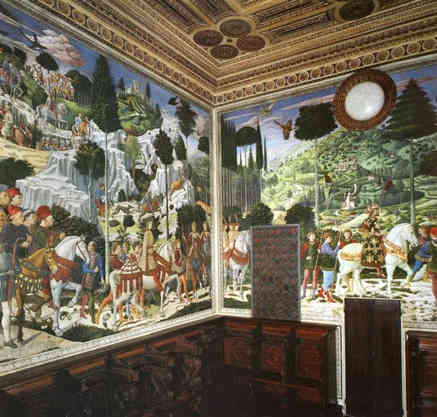
If figurative representation is taken to be an indication of popularity, there were few other cities in Italy which gave such importance to the 6th January, so many are the paintings of the Adoration of the Magi in Florence from this period by some of the greatest artists, commissioned by some of the most important families. The most spectacular example of the subject is the frescoed chapel in the Palazzo Medici-Riccardi by Benozzo Gozzoli in 1459-60, commissioned by Piero the Gouty de’ Medici.

Detail of the back and left wall, when looking at the altar, of the private chapel in the Palazzo Medici-Riccardi.
Frescoed by Benozzo Gozzoli 1459-60, commissioned by Piero the Gouty de' Medici. 
The date of the Epiphany held even more importance for the Florentines, as it was also the day which John the Baptist, the patron saint of the city, would baptise his second cousin in the Jordon long after the Magi had visited him. This event is now celebrated in the Western church eight days after the Epiphany, on January 13, but in the Orthodox church it is celebrated on 6 January.

A Florentine lay confraternity dedicated to the three wise men (who over time become represented as kings with ever increasing symbolism) staged a re-enactment of the their journey to find the new born Jesus, the King of Kings, every few years. The confraternity was in existence from 1390, the earliest documentary evidence, when the pageant was recorded by a by-stander. It was dissolved with the expulsion of the Medici family in 1494, the ruling family being one of the longstanding active patrons of the confraternity.

2012 re-enactment of the Magi procession
The Compagnia dei Magi, staged a spectacular re-enactment of the story, using most of the city as the stage, every few years. A chronicler recorded that there seven hundred costumed men in the 1429 pageant. Herod’s palace was at the San Romolo church in the piazza della Signoria (now where Rivoire cafe is located), and then the hundreds of horsemen (the entourage for the Magi), and colourful floats with mini skits connected to the history of Florence, such as David and Goliath, make their way to Bethlehem, recreated in piazza San Marco. From the cathedral square or canto di San Giovanni (canto means ‘corner’) along the via Larga (now via Cavour) finishing in San Marco, the street was lined with grandstands, benches and boxes decorated with bunting, rugs and backing.

The pageant didn’t follow a precise route every time, nor a fixed narrative.  In the 1419 pageant, after the Magi visited Bethlehem they came back to the cathedral square where the Massacre of the Innocents was staged. So great and spectacular was the parade, the Compagnia de’ Magi were also called on by the Signoria (the government of the Republic of Florence) to stage re-enactments in times other than the Epiphany. One such time was in 1439, towards the end of the great ecumenical council that Florence had been hosting for the past few years. The most important leaders of the Orthodox and Western churches, their entourages and intellectuals, were all in the city. The splendid Festa dei Magi was included into the Festa di San Giovanni, the week-long festival held for St John the Baptist, the city’s patron saint. 

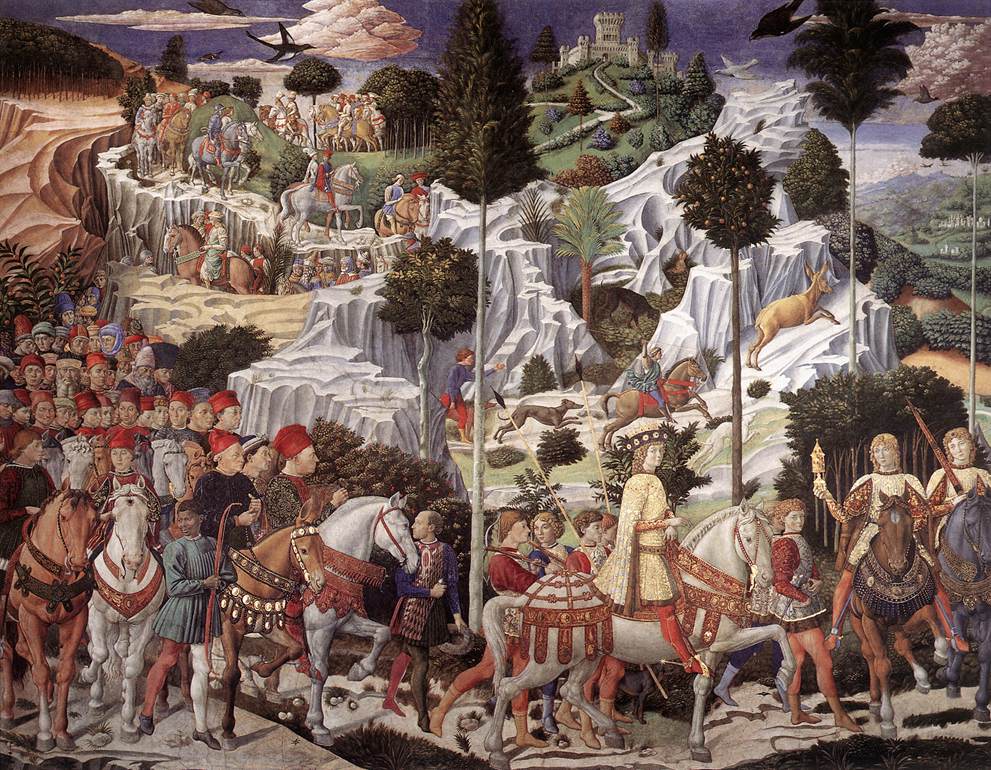
For four generations, the Medici capo di famiglia (head of family) were members of the Compagnia de Magi. In the 1459 pageant, the future Lorenzo the Magnificent, then ten years old, was an active participant. The subject was chosen by his father as the decoration of the chapel in their nearly completed Renaissance merchant home. This was the first private chapel in a private home in Italy. The underlining message here was that the Medici family were the kings of Florence in all but name and the republic was something of the past. The fresco was exquisitely executed.  Benozzo Gozzoli had trained under the sublime Dominican Observant friar, Fra Angelico in the San Marco monastery years before, another Medici funded project. The colours have a jewel-like quality and the costumes have a tactility about them that makes you want to reach out and touch them . 

Detail of the back wall in the Medici chapel, Balthazar, Benozzo Gozzoli, 1459-60, fresco, Palazzo Medici-Riccardi. 

A Magi is depicted on each wall with their accompanying entourage.  These are like the social pages of Hello! Magazine, the leading allies of the Medici family, both domestic and foreign, clearly discernible. The background is similar for all three, a running landscape with lush green hills, prime for hunting (a favourite pastime of the family), dotted with castle-villas.

Detail of right wall when facing the altar, Melchior and entourage, Benozzo Gozzoli, 1459-60, fresco, Palazzo Medici-Riccardi. Portrait of Cosimo the Elder dressed in black riding a donkey behind the Youngest Magi, his son, Piero the Gouty, to the right on a white horse. Riding a horse in the far left corner is Sigismondo Pandolfo Malatesta, Lord of Rimini, and next to him is Galeazzo Sforza, intended future ruler of Milan.  
They too all arrive, prima o poi (sooner or later), at the Christ baby to adore him, a Filippo Lippi Madonna and child (now replaced with a copy, the original is in Berlin).

Adoration of the child,  Filippo Lippi, 1459, tempera on panel, Gemaldegalerie, Berlin.